Announcement

Collapse
No announcement yet.

Global Monetary Meltdown - Part I: The accident that won't wait to happen - Eric Janszen

Collapse
X
 
  • Filter
  • Time
  • Show
Clear All
new posts

  • Chris Coles
    replied
    Re: Global Monetary Meltdown - Part I: The accident that won't wait to happen - Eric Janszen

    Originally posted by jpetr48 View Post
    Not a commodity still worth a look
    http://bit.ly/mlRfVY
    KCP&L granted nearly 21% hike
    The rate case had been grounded on paying for the costs of building the Iatan II power plant in Platte County. The new rates are scheduled to take effect June 4
    This is something that I have highlighted before. Today, we build new plant with borrowed funds; where, in the past, we built new plant with equity capital. The difference is stark! When you fund major plant build costs with borrowed funds, the modern tendency is to expect the present customer to pay for the borrowing costs, "up-front".

    In the past, using equity capital from a savings institution, the saver has to wait for the new plant to come on stream before seeing a return on their capital. ..... but, the original costs of the build are much lower, both because of not having to fund the borrowing costs and also, (and perhaps of greater importance), there is much greater incentive to keep the build costs down on the part of the savings institution.

    Banks and such that lend funding have every incentive to see the costs escalate, as their income from the project is directly related to the cost of borrowing; whereas the savings institution investing equity capital has the exact opposite incentive to keep the build costs within original limits.

    A very good example of the negative effects of borrowed funding for a major construction project was the construction of the Channel Tunnel here in Europe.

    Flawed forecasts, management mistakes and bad luck turned the Eurotunnel dream into a financial nightmare for the investors and banks who funded the project entirely from private money.

    Heavy losses - £500m last year, £1bn the year before - have meant that Eurotunnel has been unable to meet even its interest bills, much less repay capital.

    As a result, Eurotunnel has been burdened with mounting debts, like straws being loaded on a donkey's back.

    Inevitably, the company has buckled under the weight of its financial obligations.
    With debts now standing at about £6.5bn, Eurotunnel can until the end of this year service interest charges with IOUs. But thereafter the borrowing terms change and it must pay in cash.

    http://news.bbc.co.uk/1/hi/business/4088868.stm

    Leave a comment:


  • jpetr48
    replied
    Re: Global Monetary Meltdown - Part I: The accident that won't wait to happen - Eric Janszen

    Not a commodity still worth a look
    http://bit.ly/mlRfVY
    KCP&L granted nearly 21% hike

    Leave a comment:


  • thriftyandboringinohio
    replied
    Re: Global Monetary Meltdown - Part I: The accident that won't wait to happen - Eric Janszen

    Originally posted by jpetr48 View Post
    43% increase in carbon black in three price increases starting September 2010. Yet guys like Rosenberg, Hussman say there is no inflation. Hussman says wait till 2015 and beyond. Carbon black is a key raw material that enhances the performance of rubber, plastics, inks, and paints-in other words your every day essentials.

    Is it not reasonable to expect this cost push inflation to permeate wages

    http://www.columbianchemicals.com/
    Carbon black is essentially pure petroleum, burned as poorly as possible to create maximum soot (the soot is carbon black)
    May not be the best commodity to track general inflation.

    Leave a comment:


  • jpetr48
    replied
    Re: Global Monetary Meltdown - Part I: The accident that won't wait to happen - Eric Janszen

    43% increase in carbon black in three price increases starting September 2010. Yet guys like Rosenberg, Hussman say there is no inflation. Hussman says wait till 2015 and beyond. Carbon black is a key raw material that enhances the performance of rubber, plastics, inks, and paints-in other words your every day essentials.

    Is it not reasonable to expect this cost push inflation to permeate wages

    http://www.columbianchemicals.com/

    Leave a comment:


  • bart
    replied
    Re: Global Monetary Meltdown - Part I: The accident that won't wait to happen - Eric Janszen

    Leave a comment:


  • Sharky
    replied
    Re: Global Monetary Meltdown - Part I: The accident that won't wait to happen - Eric Janszen

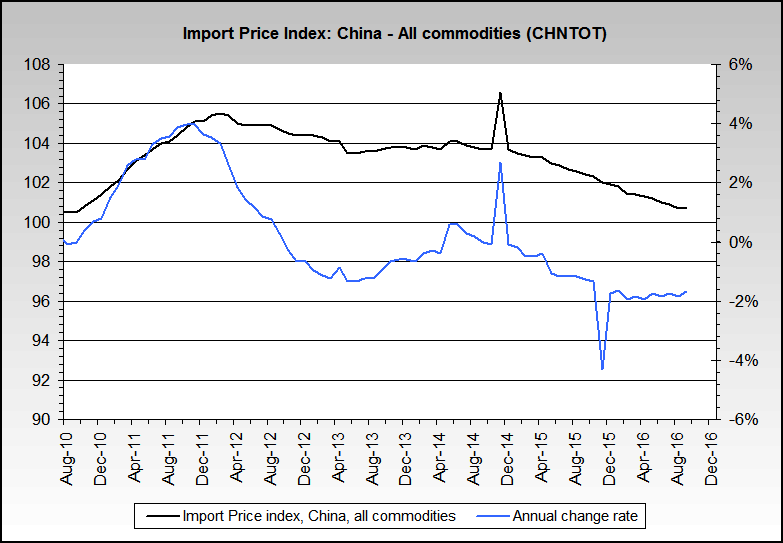
    One effect of QE in the US has been to export inflation to other countries, especially China, given the fixed peg of the yuan to the USD.

    What would happen if China decided to significantly revalue the yuan? Goods from China would have higher prices, and at the same time, the purchasing power of China in global markets -- particularly commodities -- would increase, possibly increasing prices there as well. It might cause significant unrest inside China, but is there a point where that trade-off might be worth it for them?

    Leave a comment:


  • Chris Coles
    replied
    Re: Global Monetary Meltdown - Part I: The accident that won't wait to happen - Eric Janszen

    Originally posted by Jim Bruno View Post
    Hi Chris,

    I thought you may wish to see this article, particularly as you are from the UK. Be sure to take a look at the footnotes...13 is quite direct. Jim Bruno
    http://www.leap2020.eu/GEAB-N-54-is-...use_a6340.html
    Jim, thanks for that. This other link from the same is even better:

    Britain's leaders should come clean on the true depth of the fiscal crisis

    The UK's fiscal retrenchment, we are told, is being conducted at an "extraordinarily ambitious pace". Last week's annual Budget statement pledged to "eliminate the structural deficit by 2014/15".

    http://www.telegraph.co.uk/finance/c...al-crisis.html

    By Liam Halligan, Economic Agenda 3:48PM GMT 26 Mar 2011

    But I have to say that, while there are important differences between the UK and the rest of Europe that seem to point towards disaster here in the UK; there is a way out of the dilemma for the UK, indeed, for the US as well. Investment of fresh equity capital on free enterprise terms into the grass roots via "Vanishing Bonds". But at the moment all that is stalled while my US telecom patents are being sold, (hopefully), so that I too have some form of capital base as a starting point for my campaign for The Capital Spillway Trust. So, watch this space and, as any inventor will tell you, do not hold your breath .... we get used to "setbacks".

    Leave a comment:


  • Jim Bruno
    replied
    Re: Global Monetary Meltdown - Part I: The accident that won't wait to happen - Eric Janszen

    Hi Chris,

    I thought you may wish to see this article, particularly as you are from the UK. Be sure to take a look at the footnotes...13 is quite direct. Jim Bruno
    http://www.leap2020.eu/GEAB-N-54-is-...use_a6340.html

    Leave a comment:


  • Quincy K
    replied
    Re: Global Monetary Meltdown - Part I: The accident that won't wait to happen - Eric Janszen

    Why two years? Why not five? Six? Seven? Ten?

    Why does this game, and the current System for that matter, have to end? Why can't the US continue to run deficits, deficits that everyone knows we are never going to pay back? What is going to be the catalyst for the System to fail. Who is going to call the US bluff?

    Why would any country, other than a rogue with terrorist motives, want to make a run on the Treasury market?

    Leave a comment:


  • Jay
    replied
    Re: Global Monetary Meltdown - Part I: The accident that won't wait to happen - Eric Janszen

    I still think it makes sense for the powers that be to try and implement a Carbon Money propped up by an international carbon tax. I don't know if it is implementable, but I bet they are thinking about it. Then everyone who makes money off of the existing fiat system can keep on living like kings and the printing continues via more debt.

    Leave a comment:


  • gnk
    replied
    Re: Global Monetary Meltdown - Part I: The accident that won't wait to happen - Eric Janszen

    Good point. Basic double entry book keeping. A trade surplus relies on someone else having a trade deficit. It's mathematically impossible for every nation in the world to have a trade surplus.

    Leave a comment:


  • jk
    replied
    Re: Global Monetary Meltdown - Part I: The accident that won't wait to happen - Eric Janszen

    Originally posted by gnk
    The world economy can then rebalance itself, but the free ride the West enjoyed will be over. The West will have to re-earn that gold thru trade. There is no way around that, regardless of the solution chosen.
    the other ride that will be over is export-led growth in the em's. that will be [almost?] as big an adjustment for them as what will happen in the west.

    Leave a comment:


  • gnk
    replied
    Re: Global Monetary Meltdown - Part I: The accident that won't wait to happen - Eric Janszen

    The re-balancing with gold is already occurring.

    We think of the East as having the surplus, and the west as having the debts. But let's look at it another way:

    The East has a surplus of Western paper promises, which are diminishing in value.

    The West has most of the gold, which is increasing in value.

    It's just a matter of time... Debt jubilee? too destructive, think double entry book keeping... War? Now that's really destructive, would make WWII look like tame.

    Leave a comment:


  • c1ue
    replied
    Re: Global Monetary Meltdown - Part I: The accident that won't wait to happen - Eric Janszen

    Originally posted by gnk
    I have said, before, short of an all out global war, only revalued gold can rebalance the world economy.
    The only way revalued gold can rebalance the world economy is if there is a debt jubilee right before the change.

    I sincerely doubt that would happen.

    Secondly even with a debt jubilee, a conversion to 'hard' currency or even 'firm' currency like an SDR with PM component still results in a massive recession in the US, UK and much of the EU. This blows back to Asia immediately.

    IMO, no one whatsoever in the present situation has any desire to change anything of significance - either in Asia or the West.

    The BRICs will just continue their growth, including inter-BRIC and inter-BRIC trade partner trade, which is anyway significantly divorced from the mainstream US dollar world reserve currency trade. When/if a balance of payments crisis arises in the West, the BRICs will get hurt, but the alternative systems will provide a growth path out whereas the West will have to do it the hard way: massive Latvian style cuts combined with decades of recession.

    Leave a comment:


  • gnk
    replied
    Re: Global Monetary Meltdown - Part I: The accident that won't wait to happen - Eric Janszen

    A purely paper/fiat/debt based SDR including the RMB only spreads around the "exorbitant privilege" of having a reserve currency and appeases China to a degree, but that however, does not address the severe surplus/debt imbalances between East and West, particularly, the US debt. I have said, before, short of an all out global war, only revalued gold can rebalance the world economy.

    So I would agree with you that a SDR would need some real asset backing.

    I also see an interesting long term development. After WWII, the US had 22,000 tons of gold. A large part of that migrated to its major trading partners - mostly in Western Europe. Now I see the next stage involving another gold migration - from the US/EU to Asia/BRICS.

    The world economy can then rebalance itself, but the free ride the West enjoyed will be over. The West will have to re-earn that gold thru trade. There is no way around that, regardless of the solution chosen.

    Leave a comment:

Working...
X