
Originally posted by EJ
View Post
-
Re: The committee to destroy the USA - Eric Janszen
So will the next recession be triggered by politicians who actually plan on implementing their campaign promises? This isn't your father's Republican party and I fully expect them to do what they say they're going to do. -
Re: The committee to destroy the USA - Eric Janszen
Lets not forget about the Spanish Empire of 1500-1600 (approx ?) - a very powerful Navy that once ruled the seas - the empire became addicted to silver from the 'New World". The 'printing press' for the Spanish Monarchs was the Silver found in the 'New World'. The Business of the Empire would come to a stand still when deliveries of Silver were interrupted by Pirates - encouraging Pirating became an important strategy for Spain's enemy England.
Massive global Military might has through out the ages required great wealth or a Printing Press. Neither strategy works forever......Leave a comment:
-
Re: The committee to destroy the USA - Eric Janszen
Great thread EJ, thanks.Leave a comment:
-
Re: The committee to destroy the USA - Eric Janszen
The fact of the dependence of the US economy on government spending to continue to expand the money supply is well understood by policy makers.Originally posted by magicvent View Post
That means that no matter what anyone says the spending will continue. You will hear about spending reductions and austerity as a campaign platform but it isn't going to happen, and at this point it shouldn't. Dependence on fiscal stimulus at the zero bound of interest rates is well understood, as explained in Richard Koo's 2008 analysis that we covered here at the time. Remove the stimulus "too early" and an economy in a balance sheet recession contracts.

The policy that is being pursued is that of using the government's balance sheet to substitute for household balance sheets while they pay down bubble era debts.

As to your question about deflation, if for some reason candidates who are now marketing themselves as fiscal reformers to get elected by conservatives in fact engage in fiscal reform, the most extreme outcome is a brief run-on-the-bank deflation as capital flight drains the system, followed by a soft default, say, a suspension of interest payments on foreign debt. This is akin to the period when panicked depositors withdraw money from a bank they are afraid might fail, draining funds, and causing the event they fear. It's not a lengthy deflation process, lasting usually weeks or months. In an extreme case it looks like this, as happened to Argentina in 2001 as investors fled the local currency into dollars, thus causing the very outcome they feared, a debt and currency crisis.
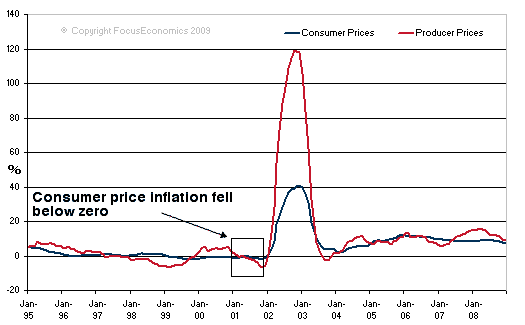
Long time iTulip readers will recognize this as the "Kap-Poom" process. The US case cannot be this severe because the US has a buffer: it owes its foreign debt in dollars, so there is no other currency for investors in dollar assets to flee to except the euro, yen, and of course the fourth currency, gold -- which is why the gold price is rising.
The relevance to us is that while Argentina had been drifting in and out of recession for a decade, and the debt-to-GDP ratio had ratcheted up over the period. Before the crisis, unemployment was high and rising.
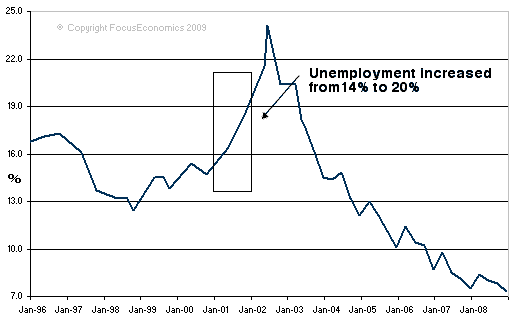
Argentina was not in a balance sheet recession. In fact, the inflation of the previous decade wiped out the debts of households, the hard way. Our precariousness results from the fact that we are in a balance sheet recession and dependent on government spending to support the money supply, as Japan has been starting in 1992. But unlike Japan, and like Argentina, the US is a net debtor. Given total public debt-to-GDP that will trigger a crisis, but no one knows what it is. For Argentina in 2001 it was 55%. We're close 100%, but then we're not a small, politically isolated economy that owes money in foreign currencies, nor do we have a long history of sovereign debt defaults and high inflation.
The way a US version of such a crisis will happen, if it does, is not that the government will suddenly increase spending and that will cause a jump in the debt-to-GDP ratio past the threshold. What happens is that an external event occurs that triggers a recession. In the case of Argentina in 2000 that triggered the 2001 crisis it was technology bubble crash in the US, Argentina's largest creditor via the IMF, and the recession that followed. At the same time foreign lending dried up, the recession shrank GDP relative to already high debt levels, pushing the ratio past the threshold.
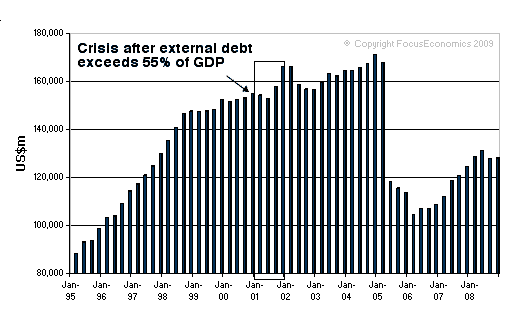
In our case, a crash in China that both takes away a source of lending to finance US government expenditure and leads to a new US recession might trigger a "Argentina Ka-Poom with US Characteristics." Another possibility that I go into in detail in thepostcatastropheeconomy is a recession triggered by the next Peap Cheap Oil Cycle. The event will be preceded by a reversal of net capital inflows. If they reverse for two quarters in a row, we can expect a crash that makes 1987 look like a cocktail party. That's why we watch them through our contacts like a hawk. The quarterly data are reported too late to act on.
But the extreme scenario is not the most likely. More likely is a near miss of this event, brought about by market perceptions based on the US election cycle.
You may recall from earlier analysis that announced the official end of the First Bounce of the Debt Deflation Bear Market in April 2010 that the stock market in a balance sheet recession correlates both to the fact of fiscal stimulus and market expectations of future fiscal stimulus.
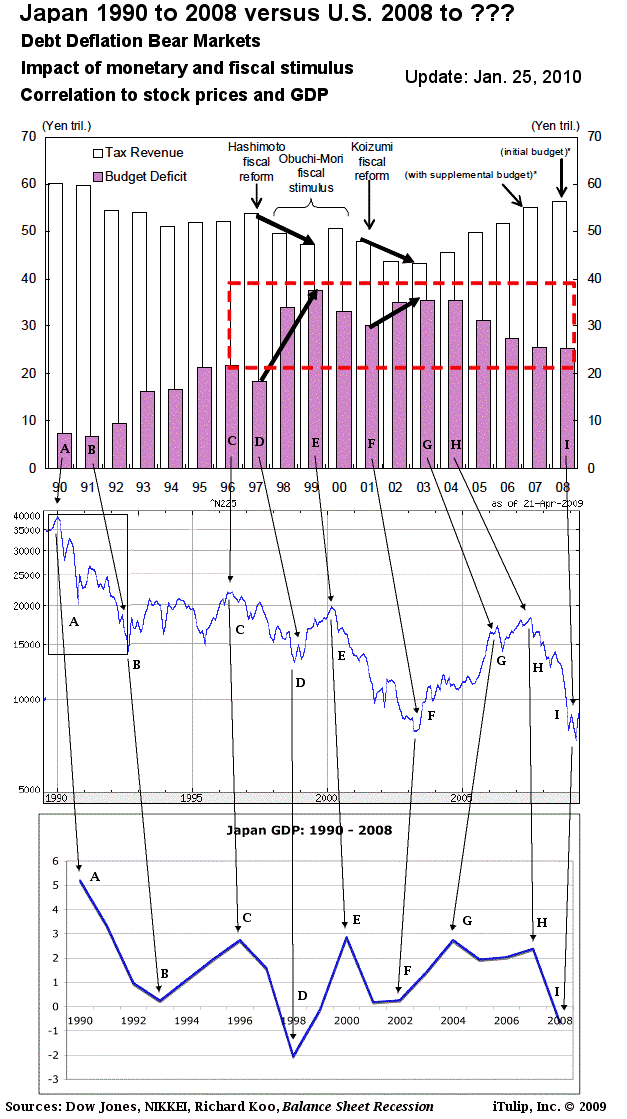
We may be approaching the end of the second bounce as the election arrives. The consensus among traders and money managers I know is that everyone is lining up to buy after the November election because stocks "always go up" after mid-term elections. But we also know that there are enough traders who understand this post-election herd mentality of fund managers that there are many traders to get on the other side of it. That makes shorting the post-election market hazardous, as does going long. So we're going to sit it out.
A final point on Koo and the balance sheet recession stimulus orthodoxy. I agree with the points that Koo makes that, under the circumstances, since our leadership made the mistake of allowing a balance sheet recession to develop in the first place by failing to stop the housing bubble as we warned them to in 2002,that ongoing stimulus to maintain money supply growth is necessary, unfortunately. But we part company on one major point. Fiscal stimulus is not a "cure" for a balance sheet recession it is a political accommodation. The only "cure" is to write off the credit bubble era debt. That's the point of my article.Last edited by FRED; September 17, 2010, 12:45 PM.Leave a comment:
-
Re: The committee to destroy the USA - Eric Janszen
I would say that a 40% devaluation over a period of months qualifies as a collapseOriginally posted by jpatter666 View Post
Having said that, I would be curious if EJ agrees with your assessment, because I remember him talking about a 40% devaluation over a period of years. The only exception is the "sudden stop" possibility, which seems to be in conflict with his reserve currency theory.
Re: Russian military. I will have to concede that point to you. Dude, don't harsh my mellow. I am trying to be optimistic here.
Leave a comment:
-
Re: The committee to destroy the USA - Eric Janszen
Depends on how you define "collapse". If you mean a hyper-inflationary Weimar scenario, I'm doubtful. If you mean Argentina where the currency devalues (say for the $ on DXY from 82 to 50/60 range) in a matter of months (or weeks) then I think that is quite possible.Originally posted by ViC78 View Post
The military won't matter for much -- not like Russia's saved them, did it?Leave a comment:
-
Re: The committee to destroy the USA - Eric Janszen
I am confused about the "currency going bananas" forecast. On one hand, EJ has repeatedly pointed out that reserve currencies do not suddenly collapse, they are wound down over a long period of time (for example, the pound sterling). Where does the Argentina scenario fit into this observation?Originally posted by Milton Kuo View Post
Also, if the theory about reserve currencies is true, how does the US "run out of credit" ?
I think people who are looking for the collapse of the dollar will be dissapointed. The most well armed military in the world should count for something, in the worst case.Leave a comment:
-
Re: The committee to destroy the USA - Eric Janszen
Oh certainly. In fact, the oscillations might be greater.Originally posted by Milton Kuo View Post
The next Ka (should we experience one) might be even more significant than 2008. This will give the Fed the excuse to run the presses full board and here comes the Poom.
This is why I keep a serious diversification of assets -- so I can run in any direction.Leave a comment:
-
Re: The committee to destroy the USA - Eric Janszen
Eric might also be referring to a brief period of deflation before the currency goes bananas, which he stated in his article, Does USA 2009 = Argentina 2001? That is, the subsequent poom is going to dwarf the poom we've seen so far.Originally posted by jpatter666 View PostLeave a comment:
-
Re: The committee to destroy the USA - Eric Janszen
Sounds like the the left is reverting to form and attacking the messenger. Next, they will vilify "speculators"Originally posted by dpandorf View PostLeave a comment:
-
Re: The committee to destroy the USA - Eric Janszen
My understanding is that there will be no deflationary spiral. It's possible to get another brief 2008-style shock.Originally posted by magicvent View PostLeave a comment:
-
Re: The committee to destroy the USA - Eric Janszen
EJ --
In the above you say that "As consumer credit outstanding continues to contract, a corresponding rise in government borrowing to compensate for the decrease in private sector borrowing is required to keep the money supply from imploding. If that happens the economy will enter a brief deflationary crisis..."
Isn't this counter to your previous position that there won't be deflation?Leave a comment:
-
Re: The committee to destroy the USA - Eric Janszen
I'm not EJ but this is an easy one to answer: you can't reverse the securitization process, the same way you can't unbake a cake. It's a one-way process.Originally posted by oddlots View PostLeave a comment:
-
Re: The committee to destroy the USA - Eric Janszen
As gold and silver make new highs, its interesting to see what our congress may do:
Congressmen Weiner and Waxman Set Gold HearingLeave a comment:
-
Re: The committee to destroy the USA - Eric Janszen
Fed will take it.Originally posted by EJ View Post
Paulson guaranteed the holders to ease the pressure. But for how much longer.
Start:8:30min
http://wwsg.com/warren-buffetts-inte...retary-paulson
Pressures building.
http://www.reuters.com/article/idUSTRE68F1GY20100916
A recap on Balance Sheet recession for those that missed it.
http://www.itulip.com/forums/showthr...57848#poststop
http://www.itulip.com/forums/showthr...45873#poststop
http://csis.org/multimedia/video-eco...on-richard-kooLeave a comment:


Leave a comment: