Originally posted by cjppjc
View Post
Announcement
Collapse
No announcement yet.
Everyone is wrong, again – 1981 in Reverse Part I: The Great Divide – Eric Janszen
Collapse
X
-
Re: Everyone is wrong, again – 1981 in Reverse Part I: The Great Divide – Eric Janszen
Yes (don't worry, third post is the charm), Yes, and Yes
-
Guest repliedRe: Everyone is wrong, again – 1981 in Reverse Part I: The Great Divide – Eric Janszen
Whatever that means.
Originally posted by cjppjc View PostI'm sticking with biflation:cool:
Leave a comment:
-
Re: Everyone is wrong, again – 1981 in Reverse Part I: The Great Divide – Eric Janszen
Even with 20% U3 in the US, unemployment seems to have troughed at much lower levels in China, India, Brazil, and other relatively fast-growing economies. As demand picks up elsewhere in the world (and perhaps stabilizes in the US with massive government stimulus), with supply constrained, prices for consumables will rise.Originally posted by jk View Posthow does this timing reconcile with the prediction of 20% u3 unemployment?
Leave a comment:
-
Re: Everyone is wrong, again – 1981 in Reverse Part I: The Great Divide – Eric Janszen
Originally posted by $#* View PostHmmm.... Nobody wants to touch the subject of disinflation any more. I guess that leaves just me and metalman as defenders of the disinflation cause.
I'm sticking with biflation:cool:
Leave a comment:
-
Re: Everyone is wrong, again – 1981 in Reverse Part I: The Great Divide – Eric Janszen
Hmmm.... Nobody wants to touch the subject of disinflation any more. I guess that leaves just me and metalman as defenders of the disinflation cause.
Leave a comment:
-
Re: Everyone is wrong, again – 1981 in Reverse Part I: The Great Divide – Eric Janszen
Ej/Fred:-
http://www.guardian.co.uk/business/2...-foreign-goods
Mike
Leave a comment:
-
Re: Everyone is wrong, again – 1981 in Reverse Part I: The Great Divide – Eric Janszen
my read on this jk is that we're going to see a nominal improvement in gdp in q3 2009 and a temporary recovery in unemployment. then things turn down again in q4. even if unemployment keeps rising and demand falls faster than supply... maybe credit for producers improves?... that sill leaves the other 8 ways of inflation.Originally posted by jk View Postmy point is more that very high unemployment means very low levels of demand, so that supply constraints are less likely to bite. otoh, if supply constraints are causing cost-push inflation, it implies a level of demand inconsistent with the very high levels of unemployment predicted.
it will take some time for a 20% u3 to emerge, even if we ratchet up [down?] to losing 1,000,000 jobs per month. but q3 is only a few months away.
trying to reconcile these ideas, it looks to me like the implicit prediction is for a false glow of health to appear with price rises in q3, with another leg down in the economy happening sometime thereafter, with the high unemployment achieved later, and with another sell-off in commodities likely to occur at that time.
is that what you have in mind?
what if the usa hits a wall on spending in the next fiscal spin cycle... in 2010?
the more i read this stuff the more clear to me it is that there are so many variables at work... market and political and random... who really knows what the hell is going to happen? whatever it is, a 1930's deflation spiral or 1990's japan deflation drift is low probability.
Leave a comment:
-
Re: Everyone is wrong, again – 1981 in Reverse Part I: The Great Divide – Eric Janszen
my point is more that very high unemployment means very low levels of demand, so that supply constraints are less likely to bite. otoh, if supply constraints are causing cost-push inflation, it implies a level of demand inconsistent with the very high levels of unemployment predicted.Originally posted by FRED View PostNo wage price inflation channel is assumed.
it will take some time for a 20% u3 to emerge, even if we ratchet up [down?] to losing 1,000,000 jobs per month. but q3 is only a few months away.
trying to reconcile these ideas, it looks to me like the implicit prediction is for a false glow of health to appear with price rises in q3, with another leg down in the economy happening sometime thereafter, with the high unemployment achieved later, and with another sell-off in commodities likely to occur at that time.
is that what you have in mind?
Leave a comment:
-
Re: Everyone is wrong, again – 1981 in Reverse Part I: The Great Divide – Eric Janszen
This is easier to read.Originally posted by brendan View PostEJ is using the wrong graph for CPI, I think--it would be clearer if he used the graph showing the % change from a year prior: http://research.stlouisfed.org/fred2/graph/?&chart_type=line&graph_id=0&category_id=&recession_bars=On&width=630&height=378&bgcolor=%23B3CDE7&graph_bgcolor=%23FFFFFF&txtcolor=%23000000&preserve_ratio=true&&s_1=1&s[1][id]=CPIAUCSL&s[1][transformation]=pc1&s[1][scale]=Left&s[1][range]=Max&s[1][cosd]=1947-01-01&s[1][coed]=2009-03-01&s[1][line_color]=%230000FF&&s[1][mark_type]=NONE&s[1][line_style]=Solid&s[1][vintage_date]=2009-04-30&s[1][revision_date]=2009-04-30
Unfortunately the data in this set doesn't go back prior to WWII.

Leave a comment:
-
Re: Everyone is wrong, again – 1981 in Reverse Part I: The Great Divide – Eric Janszen
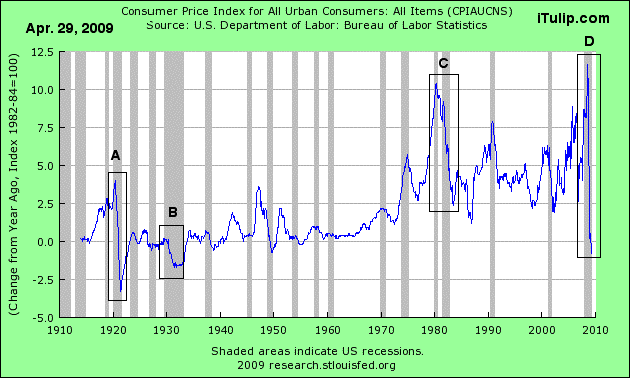
EJ is using the wrong graph for CPI, I think--it would be clearer if he used the graph showing the % change from a year prior: http://research.stlouisfed.org/fred2/graph/?&chart_type=line&graph_id=0&category_id=&recession_bars=On&width=630&height=378&bgcolor=%23B3CDE7&graph_bgcolor=%23FFFFFF&txtcolor=%23000000&preserve_ratio=true&&s_1=1&s[1][id]=CPIAUCSL&s[1][transformation]=pc1&s[1][scale]=Left&s[1][range]=Max&s[1][cosd]=1947-01-01&s[1][coed]=2009-03-01&s[1][line_color]=%230000FF&&s[1][mark_type]=NONE&s[1][line_style]=Solid&s[1][vintage_date]=2009-04-30&s[1][revision_date]=2009-04-30Originally posted by MarkL View PostEric, From a purely historical perspective, it doesn't appear that inflation typically follows deflation as rapidly as you're predicting. To take
the 1922 example that you say is similar to today, the CPI merely went back to 0%, held for a few years, followed by further deflation.
In fact, in the 1922 example we don't see the CPI even reach 3% until after WWII some 20 years later.
Let's look at the other examples:
While all of these are "sharp reversals" they are not sharp reversals to inflation, but rather reversals to the median CPI for that period.
In 1933 "B" we trundle along the bottom for 3 years and then reverse... to zero CPI.
In 1980 "C" the reversal takes us to less significant inflation than we had... and since then the mean has been in that 2.5-5% arena
until recently due to oil.
To summarize, there is arguably no historical precedent where deflation has quickly and immediately (within a year) reversed to
significant inflation. Even the significant inflation we experienced from 1975-1979 wasn't really preceded by a significant deflationary period.
So why is this situation different from every other time? Why isn't it more historically likely that we'll reverse to 2%-4% (recent mean) and float
around that mean for 5 years as happened in BOTH 1980 and 1922?
Unfortunately the data in this set doesn't go back prior to WWII.
Leave a comment:
-
Re: Everyone is wrong, again – 1981 in Reverse Part I: The Great Divide – Eric Janszen
how does this timing reconcile with the prediction of 20% u3 unemployment?Originally posted by ejAs previously noted, starting in Q3 2009 we should start to see the inflationary impact of the credit crunch induced supply crash.
Leave a comment:
-
Re: Everyone is wrong, again – 1981 in Reverse Part I: The Great Divide – Eric Janszen
So the D area in the chart below should be read as disinflation?
Leave a comment:
-
Re: Everyone is wrong, again – 1981 in Reverse Part I: The Great Divide – Eric Janszen
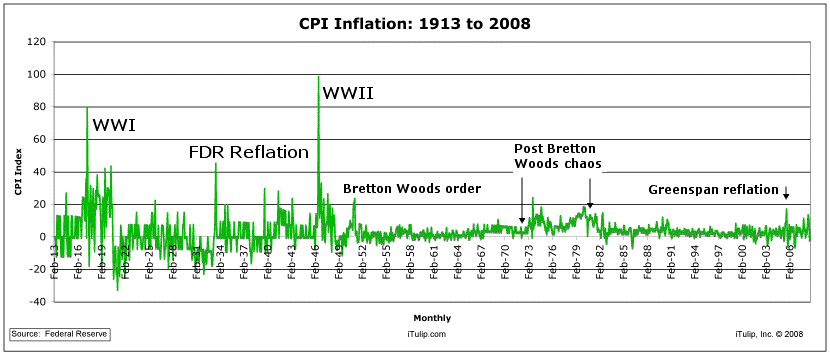
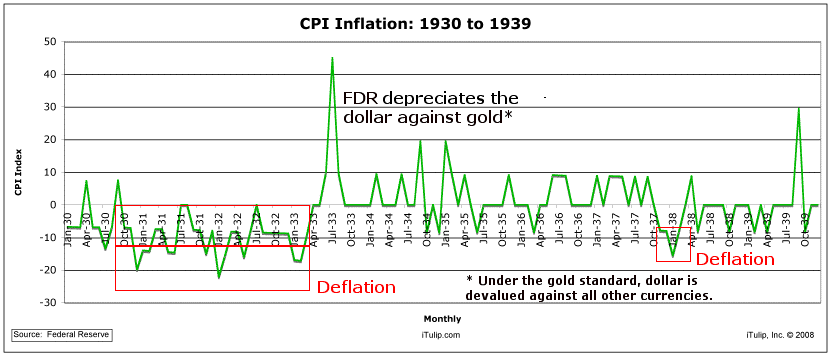
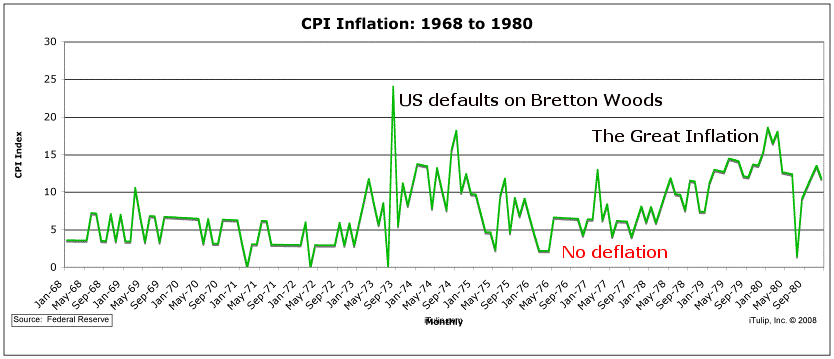
Your information is incorrect. From The truth about deflation:Originally posted by MarkL View PostEric, From a purely historical perspective, it doesn't appear that inflation typically follows deflation as rapidly as you're predicting. To take
the 1922 example that you say is similar to today, the CPI merely went back to 0%, held for a few years, followed by further deflation.
In fact, in the 1922 example we don't see the CPI even reach 3% until after WWII some 20 years later.
Let's look at the other examples:
While all of these are "sharp reversals" they are not sharp reversals to inflation, but rather reversals to the median CPI for that period.
In 1933 "B" we trundle along the bottom for 3 years and then reverse... to zero CPI.
In 1980 "C" the reversal takes us to less significant inflation than we had... and since then the mean has been in that 2.5-5% arena
until recently due to oil.
To summarize, there is arguably no historical precedent where deflation has quickly and immediately (within a year) reversed to
significant inflation. Even the significant inflation we experienced from 1975-1979 wasn't really preceded by a significant deflationary period.
So why is this situation different from every other time? Why isn't it more historically likely that we'll reverse to 2%-4% (recent mean) and float
around that mean for 5 years as happened in BOTH 1980 and 1922?


Leave a comment:
Leave a comment: