
 Tweet
Tweet
 |
March 20, 2007 (iTulip)
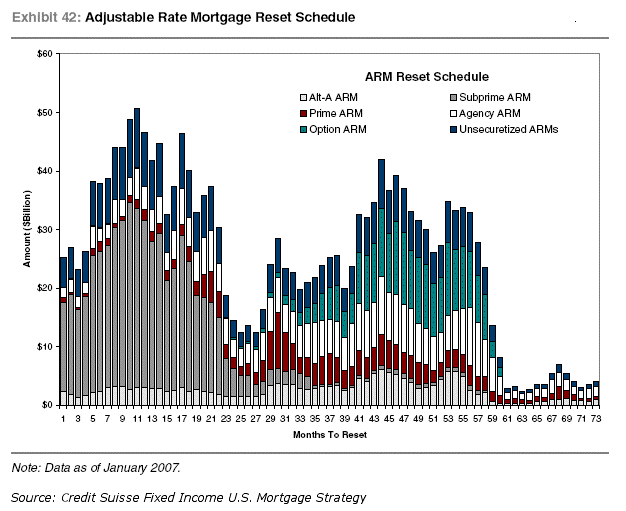
The U.S. housing market swallowed an egg. Two eggs, actually. The chart below shows one "egg" of loans re-pricing between three to 19 months from now, and another in a couple of years. The first egg is of the hard boiled subprime variety, the second a mix of prime, option and other non-subprime adjustable mortgages.
All that re-pricing means many billions of dollars that consumers will be paying for mortgages over the next few years, unless Big Al, who recommended ARMs in 2004, gets the last laugh after all. Maybe knows something we don't, like that we're going to see a massive asset deflation that drives down interest rates.
You can't throw a beer can out the window without hitting a reporter writing or talking about the bursting housing bubble.
This afternoon, NPR featured foreclosed on former property owners on a show about sub-prime loans. Newspapers ranging from the Wall Street Journal to your local rag are plastered with news of housing distress. It's enough to make a contrarian want to call a bottom. Just in time, along comes the Commerce Department today with the news that new home construction rebounded in February.
Home Construction Rebounds in February
March 20, 2007 (Martin Crutsinger - AP Economics Writer)
Housing Construction Rebounds, but Drop in Building Permits Seen As Worrisome
New home construction rebounded in February following a steep January slide. But analysts pointed to a further decline in building permits as a worrisome signal of future problems for the troubled housing industry.
Alas, it is the second sentence that is most relevant: fewer permits means less building to come. Today we add another month to our housing permit recession prediction chart from October 2006.March 20, 2007 (Martin Crutsinger - AP Economics Writer)
Housing Construction Rebounds, but Drop in Building Permits Seen As Worrisome
New home construction rebounded in February following a steep January slide. But analysts pointed to a further decline in building permits as a worrisome signal of future problems for the troubled housing industry.
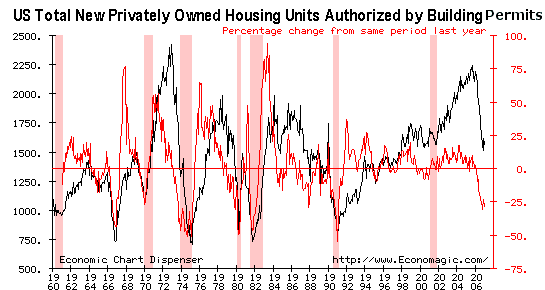
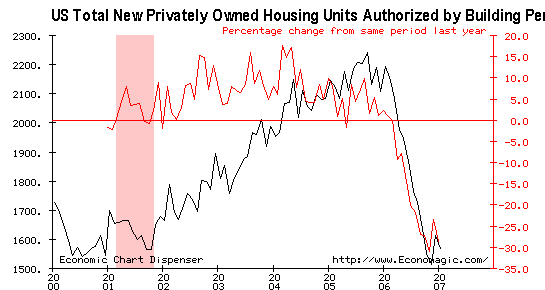
Since 1960, the U.S. economy has only experienced one recession not associated with a major decline in housing permits, the 2001 recession that followed the dot com and telco crash. The U.S. economy has never failed to experience a recession after housing permits issued declined more than 25% year-over-year. No exceptions. The new permits data show permits below the 25% Y-o-Y decline level and falling, after a slight bounce in December 2006.
As long as Uncle Sam keeps creating new death and destruction products and services jobs to compensate for recent declines in jobs selling mortgages to drug addicts and poor old ladies, home prices will continue to drift down rather than crash. The relationship between jobs and home prices that we explained back in December 2005 holds. This chart is from the FDIC in 2004.

That said, in areas of the U.S. where the last vestiges of the Production/Consumption (PC) Economy dissipate and are not replaced by Finance, Insurance, and Real Estate (FIRE) Economy jobs, housing prices can collapse.
Houses cheaper than cars in Detroit
March 20, 2007 (Kevin Krolicki - Reuters)
With bidding stalled on some of the least desirable residences in Detroit's collapsing housing market, even the fast-talking auctioneer was feeling the stress.
"Folks, the ground underneath the house goes with it. You do know that, right?" he offered.
After selling house after house in the Motor City for less than the $29,000 it costs to buy the average new car, the auctioneer tried a new line: "The lumber in the house is worth more than that!"
Speaking of crashes, chalk up another convert to Ka-Poom Theory, none other than Rich Dad, Poor Dad author Robert Kiyosaki. March 20, 2007 (Kevin Krolicki - Reuters)
With bidding stalled on some of the least desirable residences in Detroit's collapsing housing market, even the fast-talking auctioneer was feeling the stress.
"Folks, the ground underneath the house goes with it. You do know that, right?" he offered.
After selling house after house in the Motor City for less than the $29,000 it costs to buy the average new car, the auctioneer tried a new line: "The lumber in the house is worth more than that!"
The Slow-Motion Stock Market Crash
I predict that if there is a recession, current Fed chairman Ben Bernanke (and, in an attempt to hold onto the White House, the Republicans) will flood the market with more money at lower interest rates.
Then the purchasing power of the dollar will once again drop, asset prices may rise, and the financially naive will actually believe that the value of their assets -- houses, stocks, and mutual funds -- have gone up in value.
Actually, Ka-Poom, Real Dow, and our 2001 Gold Prediction all rolled into one. Welcome to the club, Robert!I predict that if there is a recession, current Fed chairman Ben Bernanke (and, in an attempt to hold onto the White House, the Republicans) will flood the market with more money at lower interest rates.
Then the purchasing power of the dollar will once again drop, asset prices may rise, and the financially naive will actually believe that the value of their assets -- houses, stocks, and mutual funds -- have gone up in value.
The iTulip ShadowFed has been meeting to decide what the FOMC is likely to do tomorrow with rates and say about the future. The ShadowFed also offers advice to the FOMC on what the Fed ought to do. One of the inputs is this chart which shows a factor that has been a feature of the U.S. bond markets for many months now, an inverted yield curve. Except for iTulip's Eric Hodges reminding us of the fact every month, the inverted yield curve would be easy to forget about, like bald tires one forgets to replace; not a problem, until it rains.
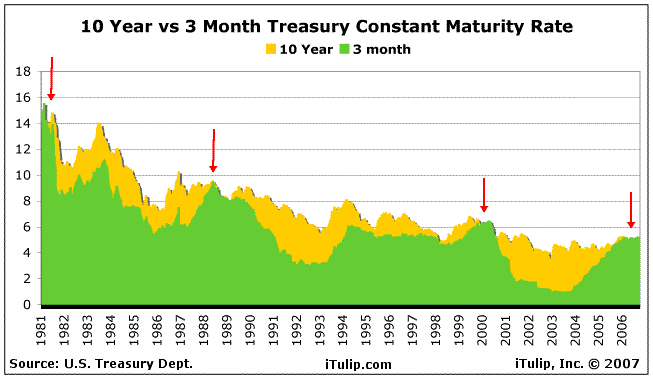
Add it all up–the drop off in building permits, a persistently inverted yield curve, and the ARM repricing eggs–and it looks like a recipe for rate cuts, if not for at least two factors that the Fed did not face the last time it considered rate cuts: $59 oil and $660 gold. Look for the ShadowFed announcement later today.


Comment