
 Tweet
Tweet
Flow of Funds Q4 2008: Debt Deflation confirmation
Buried in the details of yesterday’s quarterly Fed Flow of Funds report is the collapse of the private credit market in Q4 2008 and attempts by the Federal Reserve and Treasury Department to compensate for the loss with government credit as the world's largest lender of last resort.
Buried in the details of yesterday’s quarterly Fed Flow of Funds report is the collapse of the private credit market in Q4 2008 and attempts by the Federal Reserve and Treasury Department to compensate for the loss with government credit as the world's largest lender of last resort.
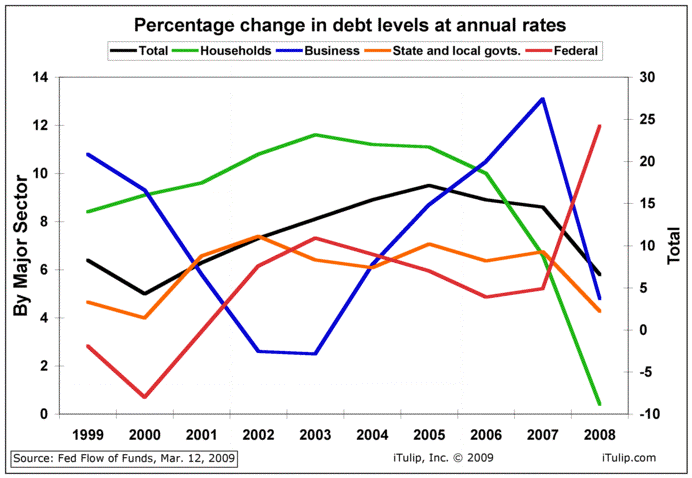
Debt growth levels declined in all sectors except US Federal. Household debt turned negative.
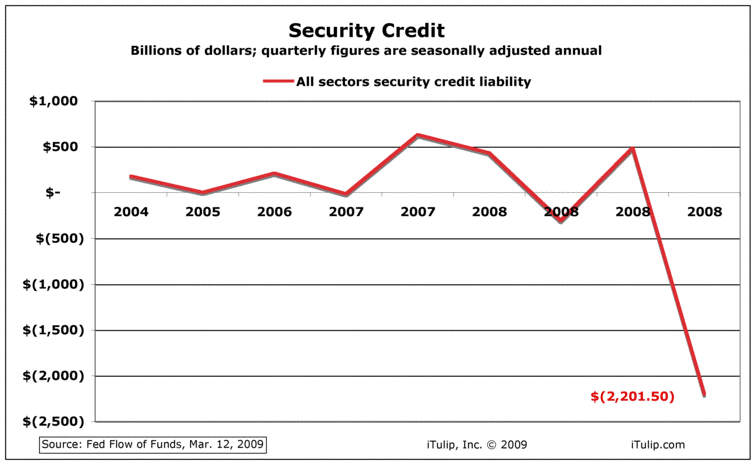
Security credit liabilities collapsed.
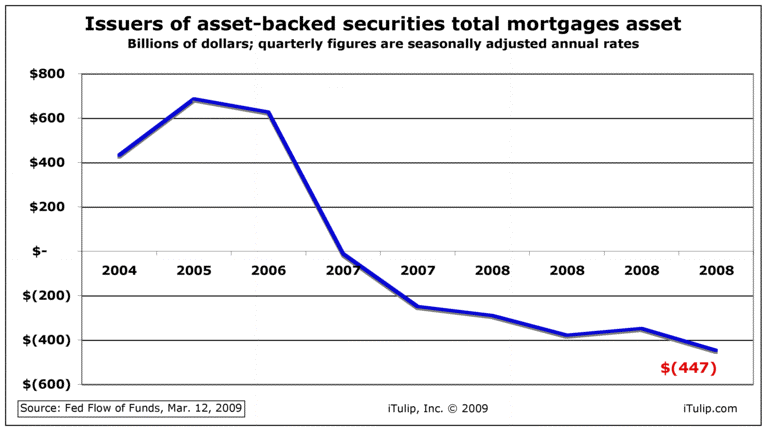
ASB assets extended a decline that started in Q1 2007.
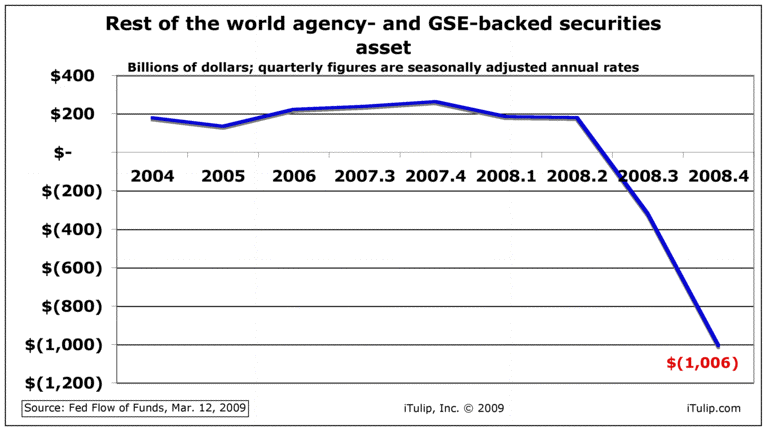
Agency and GSE securities assets collapsed.
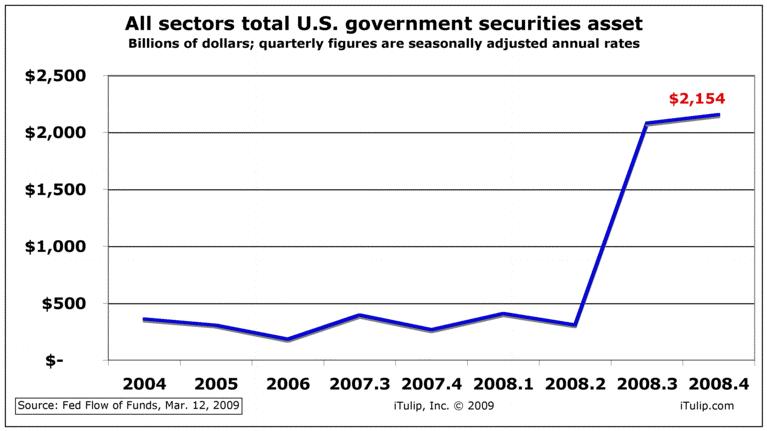
Treasury securities issuance made up part of the difference.
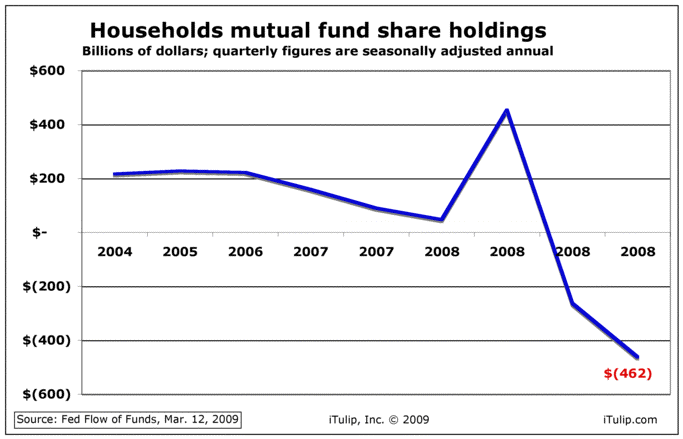
The value of household mutual funds holdings collapsed.
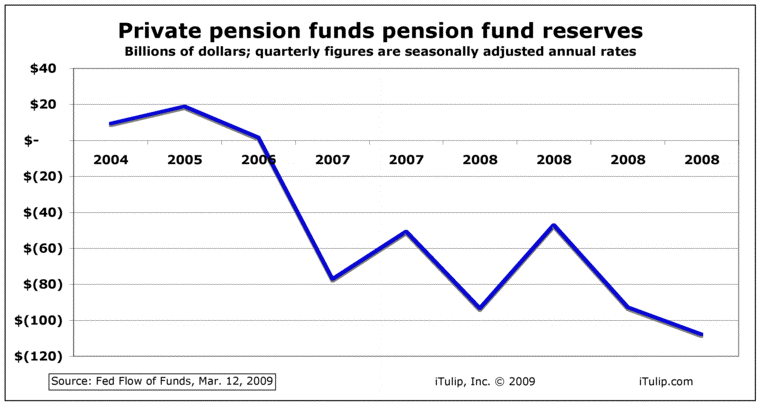
Pension fund reserves extended declines that started in 2005.
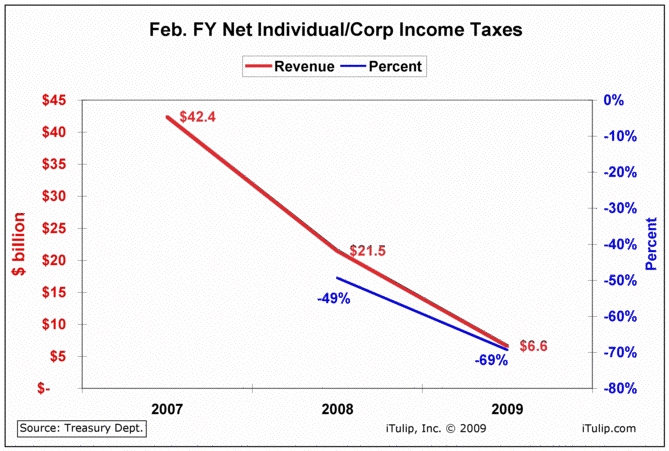
Personal and corporate income taxes declined sharply in Feb 2009 from FY 2008 and FY 2007.
Much attention is paid to the health of US banks, but a more pressing problem as the Flow of Funds reveals is that the magic securitized debt machine broke in the final quarters of 2008 that for decades fulfilled the endless demand for credit by households and businesses. Now that unemployment is rising, demand for credit is falling, and with the securitized debt machine broken, the supply of private credit has dried up, too. Where does that leave us?
Questions:
In sum, we see the risk that, much as in 2001 following the collapse of the technology stock bubble but driven by considerably more extreme circumtances, tax receipts in 2009 are vastly over-estimated while demands on the federal government to finance both fiscal stimulus and to act as a long term lender of last resort are vastly underestimated.
Perfect Storm for a Balance of Payments Crisis?
As argued in “Road to Ruin: Final stretch” the US is vulnerable to a balance of payments crisis. The cause of that crisis is the convergence of four main crisis events, and we are ready to say that these may occur within the next three quarters:
The near convergence of these events means they may occur either in sequence or more or less at the same time. For example, if clear evidence of inflation arises soon, that will cause Treasury prices to fall, and in fact may be causing them to do so already. The most likely trigger is a Tax Receipt Epiphany that leads to a Fiscal Deficit Shock and sudden loss of confidence in US sovereign credit quality.
The result in the fabled “Poom” of iTulip’s 1999 Ka-Poom Theory, a theory of the final stage of the disinflation and reflation process of the asset price inflation cycles that began in the early 1980s, began to end in early 2008 with the onset of debt deflation.
We explore the fiscal deficit shock idea in more detail in Flow of Funds in a Transformational Depression ($ubscription)
iTulip Select: The Investment Thesis for the Next Cycle™
__________________________________________________
To receive the iTulip Newsletter or iTulip Alerts, Join our FREE Email Mailing List
Copyright © iTulip, Inc. 1998 - 2007 All Rights Reserved
All information provided "as is" for informational purposes only, not intended for trading purposes or advice. Nothing appearing on this website should be considered a recommendation to buy or to sell any security or related financial instrument. iTulip, Inc. is not liable for any informational errors, incompleteness, or delays, or for any actions taken in reliance on information contained herein. Full Disclaimer
Questions:
- Can the securitized debt market be restarted? How can the supply of private credit be restored to even close to previous levels without it? (The securitized debt market will not be restored to anywhere near its previous level. Private credit markets going forward will be a function of sound investment demand, not issuance creativity.)
- Can confidence in the debt securitization model be restored in time to boost the credit supply before the economy contracts so much that credit demand falls to comatose levels?
- How can household borrowing be restored when unemployment is rising? The US economy desperately needs organic job creation to raise incomes from salaries, and high interest rates to motivate saving. (Household borrowing will never reach previous levels relative to income.)
- What will happen to GDP short term if credit supply and demand are not quickly restored? (GDP will decline precipitously. In the future a pool of savings more than credit will finance expansion.)
- What will happen to sales, income, capital gains, and property tax receipts as sales revenues fall with a decline in consumer and capital spending, incomes fall with rising unemployment, capital gains fall with declining asset prices, and property taxes fall along with property valuations? (Tax receipts will fall dramatically.)
- How can the federal government stimulate jobs creation with spending programs at the same time state governments are laying off employees in droves to meet budget restraints? (The government cannot "create" jobs, but can move them from one part of the economy to another, or from the future into the present when they are needed more. The net long term results is, however, negative. The only "solution" to the credit collapse problem is to not allow a credit bubble to develop in the first place.)
- Won’t the federal government find itself needing to finance state and local budgets to achieve the politically desired net job creation, and won't that add substantially to federal budget liabilities? (Yes.)
- How will the federal government stimulate demand by job and income growth at the same time household net worth is falling with asset prices, creating an undertow of negative wealth effects? Won’t the Federal government for political reasons need to step up the financing of public pensions, and even private ones to at least backstop those losses? (Yes, further increasing budget liabilities.)
In sum, we see the risk that, much as in 2001 following the collapse of the technology stock bubble but driven by considerably more extreme circumtances, tax receipts in 2009 are vastly over-estimated while demands on the federal government to finance both fiscal stimulus and to act as a long term lender of last resort are vastly underestimated.
Perfect Storm for a Balance of Payments Crisis?
As argued in “Road to Ruin: Final stretch” the US is vulnerable to a balance of payments crisis. The cause of that crisis is the convergence of four main crisis events, and we are ready to say that these may occur within the next three quarters:
- Epiphany that tax receipts will be dramatically lower than current estimates and expectations, creating a fiscal deficit shock (Timing: Late April or early May?)
- Epiphany that demands on the Federal budget are higher than currently expected due to extension of lender of last resort operations to finance current credit market challenges and the inclusion of new rescue operations, such as to support credit card and insurance companies, and a series of funding crises, such as public pensions, and state and local government budget shortfalls. (Timing: Ongoing)
- Supply crash meets money supply boom, resulting in rising inflation. All across the supply chain, from raw to finished goods, supply is falling. Starting with raw materials, it is easy to forget that mining is a capital-intensive process, and without credit production has slowed dramatically. Without trade credit shipping and trade have slowed dramatically. In terms of finished goods, the retail trade industry is contracting quickly. Much as occurred starting in 1975, government efforts to reflate the economy by increasing the money supply ran head long into a collapse in goods supply. Looking at trends in goods supply and money supply, a rise in inflation starting with consumer prices may have already begun. (Timing: Q4 2009 or Q1 2010?)
- Epiphany that China will as its economy contracts not be able to afford to continue to purchase US Treasury bonds despite the virtually guaranteed result, a collapse in US export demand and value of dollar denominated reserve assets. The situation will be similar to that which the US and UK found themselves in 1930, unable to continue to make payments that maintained capital inflows that the German economy depended on to finance its fiscal and current account imbalances: the German economy collapsed in a Sudden Stop event in 1931. The timing of this event is very difficult because it is political; at what point does the cost of buying Treasuries outweigh the cost of not buying them? (See Economic M.A.D.) Long before the now common warnings from China are acted on, we should see some early signs [See: Headed for a Sudden Stop). One of those signs will be investors hiding out in dollar inflation hedges like commodities and precious metals, and we take the coincidence of falling Treasury yields and rising gold prices as a sign that some investors are preparing for a Sudden Stop event. (Timing: Q3 or Q4 2009?)
The near convergence of these events means they may occur either in sequence or more or less at the same time. For example, if clear evidence of inflation arises soon, that will cause Treasury prices to fall, and in fact may be causing them to do so already. The most likely trigger is a Tax Receipt Epiphany that leads to a Fiscal Deficit Shock and sudden loss of confidence in US sovereign credit quality.
The result in the fabled “Poom” of iTulip’s 1999 Ka-Poom Theory, a theory of the final stage of the disinflation and reflation process of the asset price inflation cycles that began in the early 1980s, began to end in early 2008 with the onset of debt deflation.
We explore the fiscal deficit shock idea in more detail in Flow of Funds in a Transformational Depression ($ubscription)
iTulip Select: The Investment Thesis for the Next Cycle™
__________________________________________________
To receive the iTulip Newsletter or iTulip Alerts, Join our FREE Email Mailing List
Copyright © iTulip, Inc. 1998 - 2007 All Rights Reserved
All information provided "as is" for informational purposes only, not intended for trading purposes or advice. Nothing appearing on this website should be considered a recommendation to buy or to sell any security or related financial instrument. iTulip, Inc. is not liable for any informational errors, incompleteness, or delays, or for any actions taken in reliance on information contained herein. Full Disclaimer


Comment