
+ Reply to Thread
Page 1 of 5 1 2 3 4 5 LastLast
Results 1 to 20 of 89
  1. #1
    Join Date
    Mar 2006
    Posts
    1,510

    Default Debt Deflation Bear Market: First Bounce - Eric Janszen

    Debt Deflation Bear Market: First Bounce

    In a recession, a recovery in personal consumption, incomes, and retail sales signals the start of recovery. The virtuous cycle of credit growth--and its corollary, debt growth—combine with rising incomes as the rate of unemployment growth slows. Credit expansion leads the economy out of the cycle, followed by incomes. That is what many stock market participants think they are seeing now, as previous experience has trained them to see. But they are wrong.

    In an economy where household expenditure accounts for 71% of GDP as in the U.S. in 2008, if household cash flows from wage income declines, retail spending falls. Government through interest rate cuts and tax cuts stimulates the economy by increasing credit cash flows. This approached effectively to end every recession in the U.S. since the end of WWII. Keep in mind that each recession was created by monetary policy, by the tightening of credit in order to reduce inflation expectations, real or imagined.
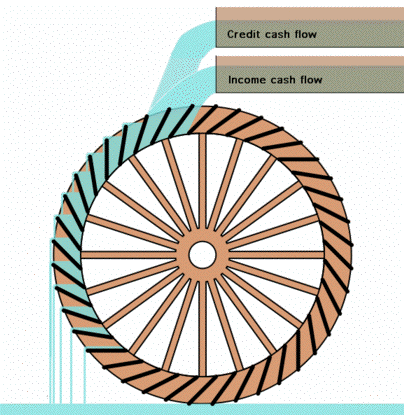


    Think of a consumer-dependent economy as a waterwheel, with household cash flow from wages and credit driving the wheel, and the wheel driving the creation of new jobs, income, and credit, pumping money into the economy. If either the credit flows or the income flows dry up, the wheel slows. If they both dry up, one after the other, the wheel slows a lot. In a recession, the government tries to get the wheel moving again by making up for private credit flows and private income flows with government credit and government jobs.

    A depression, on the other hand, happens when debt levels are so high that there is not enough cash flow from incomes or new credit creation in the economy to service the interest on the debt. The result is debt deflation and economic depression. Debt deflation started in 2006 for households when the price of their homes began to fall.

    A depression, unlike a recession, is not induced by government raising interest rates to combat inflation. On the contrary, a depression occurs in spite of all efforts by government to expand credit; interest rates are cut to zero yet the debt deflation goes on.

    Debt deflation cannot be stopped by government credit expansion because that effort only increases debt levels that are already excessive as a result of decades of previous interventions to re-start the already over-indebted economy. As the economy shrinks, there is even less income available to repay debt, and a vicious cycle sets in. The wheel not only stops, it begins to run backwards and pumps money out of the economy.

    Debt deflation at first withdraws household purchasing power from credit. Later households experience a decline purchasing power from loss of wage income as layoffs increase and savings are consumed in debt repayment. Government, by pouring vast sums of government money into the economy in an attempt to restart the virtuous credit cycle can produce a small “bounce” in the decline in aggregate demand that shows up as consumer spending, but cannot restart the wheel as it can during a recession. Debt levels continue to fall, and soon consumer expenditures as well.
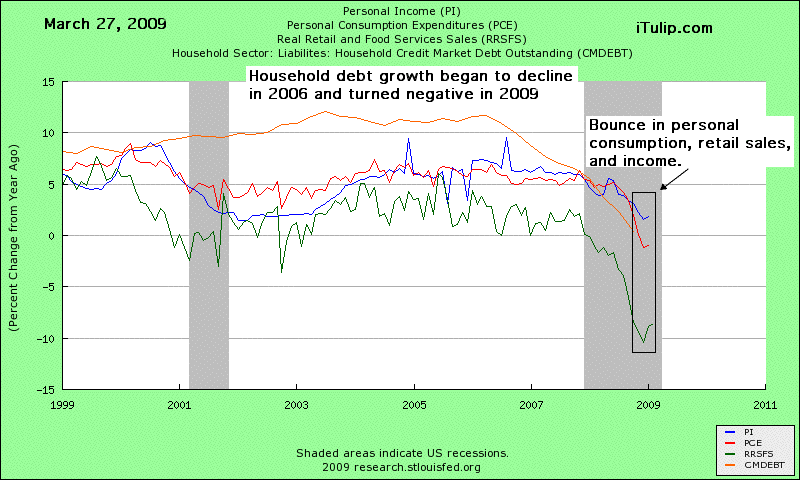


    Stock market participants are trained by previous recessions since WWII to expect a recovery after consumption expenditures turn around in response to fiscal and monetary stimulus. They are not wired to comprehend the wholly different dynamics of a debt deflation as we identified it in Dec. 27, 2007 and forecast a 40% decline in the DJIA in line with the first year decline that the Japanese stock market experienced in the first year of Japan’s debt deflation (see Time, at last, to short the market $ubscription).

    U.S. re-inflation policy has been far more aggressive than Japan’s, and the recent announcement by the Fed to begin buying Treasury bonds farther out the yield curve is motivating investors to move out of government bonds, and some of that money moved into stocks.

    This rally does not reflect an improvement in the underlying economy but the response of market participants to short term government policy in the context of a widespread misperception of the current depression as a recession.

    The stock market rally is a disconnect between investor expectations and the economy. How disconnected?
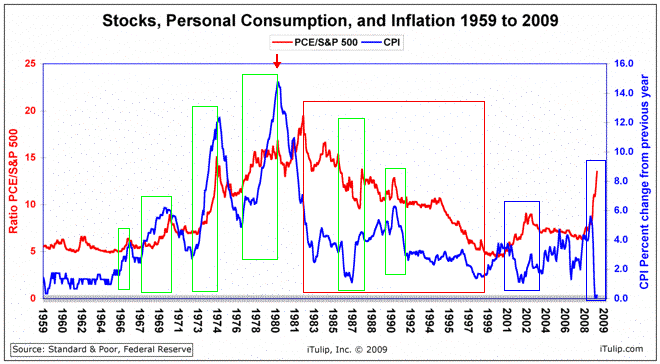

    CPI peaks lag peaks in the PCE/S&P ratio by one year in each cycle until
    the beginning of the FIRE Economy in 1980s. Over the duration of the disinflationary era
    starting in 1981 until the peak of the technology stock asset price inflation in 2000, both
    the PCE/S&P ratio and inflation declined, with periods of high correlation between the
    PCE/S&P ratio and CPI inflation one year later. The correlation turned negative for the first
    time following the extreme asset price reflation measures undertaken in 2001 that
    boosted both consumption and the S&P. The extreme negative correlation between the
    PCE/S&P ratio and CPI inflation is unique over the 50 year period.


    Japan’s experience with managing debt deflation via fiscal stimulus has been similar to that of the U.S. in the 1930s; whenever government spending was cut, the economy slumped back into depression. The U.S. finally escaped debt deflation when WWII. There is no evidence to support the belief that fiscal stimulus can end a debt deflation, but that is the belief that governments are following worldwide.

    We claim no special debt deflation bear market rally timing skills. Even after the DJIA approaches our target of 5000, we have no idea how long it will remain trading in a low range. The duration of the downturn depends on the political response to global economic contraction. The flawed philosophy and ideology of curing the debt deflation illness with further exposure to the debt disease, as the U.S. attempted in the 1930s and Japan has tried since the early 1990s, do not encourage optimism but point to a prolonged and painful period of global economic contraction.

    iTulip Select: The Investment Thesis for the Next Cycle™
    __________________________________________________

    To receive the iTulip Newsletter or iTulip Alerts, Join our FREE Email Mailing List

    Copyright © iTulip, Inc. 1998 - 2009 All Rights Reserved

    All information provided "as is" for informational purposes only, not intended for trading purposes or advice. Nothing appearing on this website should be considered a recommendation to buy or to sell any security or related financial instrument. iTulip, Inc. is not liable for any informational errors, incompleteness, or delays, or for any actions taken in reliance on information contained herein. Full Disclaimer
    Last edited by BDAdmin; 03-28-09 at 09:49 PM.

  2. #2
    Join Date
    Mar 2009
    Location
    down in the Trailerhood
    Posts
    682

    Default Re: Debt Deflation Bear Market: First Bounce - Eric Janszen

    Quote Originally Posted by EJ View Post
    The duration of the downturn depends on the political response to global economic contraction.


    Isn't the likeliest response to be another round of protectionism and isolationism? Even if you agree, that still doesn't help determine duration, does it?

  3. #3
    Join Date
    Mar 2007
    Posts
    96

    Default Re: Debt Deflation Bear Market: First Bounce - Eric Janszen

    When will you be publishing your post on portfolio allocation?

  4. #4
    Join Date
    Jul 2008
    Location
    United States
    Posts
    472

    Default Re: Debt Deflation Bear Market: First Bounce - Eric Janszen

    This whole situation is funny, because it's amazing how ridiculously stubborn some of the entities are.

    JUST FORGIVE THE DEBT ALREADY SO WE CAN BEGIN A MEANINGFUL RECOVERY!

    We all knew the banks made mistakes in how they "created" all this money, so what? Now that we know alot of the loans were bad and the actors involved were corrupted and were bribed or coerced in the process, the solution is quite simple. Remove those in power from making any more decisions, prevent them from ever doing so as long as they live, forgive all the debt, and never let people go into so much debt any more.

    The most practical solution is to address who controls the money supply and the reality is it should be NO ONE. If I want to create my own currency and I can convince enough people that they should use it as a medium of exchange, what's the big deal? Oh yeah, that's because you want the POWER to control, manipulate, and leech off the currency without actually providing any real service. That's called Usury and it is immoral.


    Quote Originally Posted by magicvent View Post
    When will you be publishing your post on portfolio allocation?
    Sheesh, he made one mention of a post thats only delayed a few days, and now that's all everyone can think about? If you know iTulip and read through it enough, you should probably already have a least a better idea of what he's going to suggest. There shouldnt be any "suspense" built up in me enough to make me ask. I can wait patiently, although I am curious what he's actually going to write.

  5. #5
    Join Date
    May 2006
    Location
    Gilroy
    Posts
    313

    Default Re: Debt Deflation Bear Market: First Bounce - Eric Janszen

    How quickly would the economy turn around with a coordinated debt forgiveness policy to the general public?

    I know it's not going to happen. In my vocation we've had occasion to meet some folks with a lot of money. Those with substantial assets are adamant about not losing money on investments. They'll unhappily accept the idiosyncracies of their investments when they do lose money knowing that they'll probably get it back in one way or another.

    But the idea of 'giving' it up to debtors is their 'Thou shall not....' 11th commandment. I suspect the banks would agree with this attitude with the caveat that it should become the first commandment with the others moving down the list as per their lesser importance.

  6. #6

    Default Re: Debt Deflation Bear Market: First Bounce - Eric Janszen

    maybe I am really dense, but this sentence was a whammy to me:

    A depression, on the other hand, happens when debt levels are so high that there is not enough cash flow from incomes or new credit creation in the economy to service the interest on the debt.


    is that really a prime issue in such a straighforward fashion? I just have not viewed it in that way before, and need to go back and look at fundamental data to see if that is even where we are.

    frankly, if that is the case, inflation and soon is one way to deal with the issue, so I guess poom here we come. It lines up with my other thoughts.

  7. #7

    Default Re: Debt Deflation Bear Market: First Bounce - Eric Janszen

    Quote Originally Posted by EJ View Post
    In an economy where household expenditure accounts for 71% of GDP as in the U.S. in 2008, if household cash flows from wage income declines, retail spending falls.

    My boss just called me (after doing annual reviews in which I got the best grade, 'Master' level) to tell me that this year my salary will be 1% less than last year. I know that company (high-end software company) is doing well, better than expected.

    I guess I was expecting a meager 1-2% increase, but not the decline .

    On one hand, I am happy to have a job and income.

    But on the other hand, I can say for sure my consumption will decline.

    I kind of expected this though. This is why I bought some necessities earlier this year (in larger quantities), simply knowing that I won't feel good about all that just a bit later.

    And guess what, now is 'a bit later', and I don't feel good about any of it at all.:mad:

  8. #8
    Join Date
    Nov 2007
    Posts
    1,569

    Default Re: Debt Deflation Bear Market: First Bounce - Eric Janszen

    For Eric Janzen: What will oil stocks and oil sands income trusts do during a period when everything goes to hell in a stock market massacre (down to DOW 5000) owing to a worldwide debt deflation? Give me the bottom-line.

    Translation: Will Starving Steve starve-to-death?

  9. #9
    Join Date
    Sep 2006
    Location
    Brisbane, Australia
    Posts
    709

    Default Re: Debt Deflation Bear Market: First Bounce - Eric Janszen

    The stock market rally is a disconnect between investor expectations and the economy. How disconnected?


    I am having trouble with this graph. The PCE/S&P is rising vertically and looks to be above average but not extremely so. The rise in the ratio is largely due to S&P falling. While PCE has declined it is yet of minor importance in this ratio. There is a somewhat similar 'disconnect' in 2001-2 although not of quite the same magnitude. Presumably, in response to the latest rally the ratio has turned down a bit. Just looking at past patterns on the graph it looks entirely possible that the ratio turns down a bit and stabilises (relatively speaking). That means PCE stabilises and the S&P stabilises (more or less). Maybe PCE can stabilise with all the low interest rates? Maybe the ratio then turns back down as the share market rises and steadily continues that way for years?
    I can't see that the graph indicates that it is axiomatic that we are in a bear market rally and the S&P collapses.
    Sorry, I just don't "get' the significance of this graph. Maybe someone can help me here?

  10. #10
    Join Date
    Apr 2008
    Posts
    18

    Default Re: Debt Deflation Bear Market: First Bounce - Eric Janszen

    Hi Eric,
    You have compare USA with Japan, but as Warren Buffett implied that Japan has 0 immigration while USA enjoys very robust immigration influx from all over the world. This means that USA is growth oriented much more than Japan.
    Don't you think comparing with Japan's economy is apples and oranges ?
    Please comment
    Best Regards
    analog2000

  11. #11
    Join Date
    Feb 2008
    Posts
    238

    Default Re: Debt Deflation Bear Market: First Bounce - Eric Janszen

    Japan’s experience with managing debt deflation via fiscal stimulus has been similar to that of the U.S. in the 1930s; whenever government spending was cut, the economy slumped back into depression. The U.S. finally escaped debt deflation when WWII. There is no evidence to support the belief that fiscal stimulus can end a debt deflation, but that is the belief that governments are following worldwide.

    I don't get this bit.

    It seems like a contradiction.

    First this:

    whenever government spending was cut, the economy slumped back into depression. The U.S. finally escaped debt deflation with WWII.
    Sounds like government fiscal stimulus does work historically. Then you say:

    There is no evidence to support the belief that fiscal stimulus can end a debt deflation, but that is the belief that governments are following worldwide.
    Do you mean that superficially government fiscal stimulus kept the economy afloat, but didn't do enough fundamentally to get the economy going (no more debt) as when the fiscal stimulus was removed, the economy tanked.

    You mean, the only thing that fundamentally worked was a world war.

    If the government left things alone, the economy would eventually recover or at least bottom out as the bankruptcies cancel the debt. The nations might not survive the unrest though. I believe bankruptcies aren't bad in the medium term though. I heard another crystal company is being started in Ireland to take the place of Waterford crystal. So, some of employees will be taken on again. New company won't have any or not the same amount of debt as Waterford crystal. As the company grows, more ex employees are taken on again.

    Why did WWII make the slate clean to start the cycle all over again? Whatever factor did this, can this factor be achieved in peacetime?

  12. #12
    Join Date
    May 2007
    Location
    Portland, OR
    Posts
    934

    Default Re: Debt Deflation Bear Market: First Bounce - Eric Janszen

    Quote Originally Posted by analog2000 View Post
    Hi Eric,
    You have compare USA with Japan, but as Warren Buffett implied that Japan has 0 immigration while USA enjoys very robust immigration influx from all over the world. This means that USA is growth oriented much more than Japan.
    Don't you think comparing with Japan's economy is apples and oranges ?
    Please comment
    Best Regards
    analog2000
    I wouldn't count on that "robust" immigration continuing.

    After a Long Climb, Foreign-Born Labor Declines

    Today the Bureau of Labor Statistics came out with its annual report on foreign-born workers in the American work force. It showed that, after more than a decade of steady growth, the portion of employed workers who were foreign-born fell slightly in 2008.
    Unemployment is rising. What kind of economic growth are you expecting if people can't find work? How many people from elsewhere will decide to not come here as they realize there may not be a source of income?

  13. #13
    Join Date
    Jun 2006
    Posts
    4,003

    Default Re: Debt Deflation Bear Market: First Bounce - Eric Janszen

    Quote Originally Posted by analog2000 View Post
    Hi Eric,
    You have compare USA with Japan, but as Warren Buffett implied that Japan has 0 immigration while USA enjoys very robust immigration influx from all over the world. This means that USA is growth oriented much more than Japan.
    Don't you think comparing with Japan's economy is apples and oranges ?
    Please comment
    Best Regards
    analog2000
    Where does the article say that the U.S. and Japan are apples and oranges? We have written dozens of articles over 10 years that state precisely the opposite, summarized below.
    Japan's starting point (1990) advantages over the USA (2009) in a debt deflation
    • Large pool of national savings, high savings rate
    • Median net worth > $100,000
    • Median household debt < 10% of net worth
    • Government a net creditor
    • Economy 80% productive (profits-based), 20% financial (capital gains and interest based)
    • Expanding global economy creating high demand for Japanese exports
    Japan's starting point disadvantages over the USA in a debt deflation
    • Stagnant population with little immigration and low birth rates
    • Oldest median age of any developed country, producing an internal demand deficit
    U.S. starting point (2009) disadvantages over the Japan (1990) in a debt deflation
    • Gross external debt 95% of GDP
    • Median net worth < $50,000
    • Median household debt 40% of net worth
    • Economy 50% productive (profits-based), 50% financial (capital gains and interest based)
    • Global depression, shrinking external demand
    Japan today after 19 years of debt deflation
    • Gross public debt up from 49% of GDP in 1990 to 195% of GDP
    • Diminished pool of savings, low savings rate
    • High personal debt levels
    Moral of the story: deflating debt against the incomes of households and businesses while moving private debt to public account does not work.

    Two alternative approaches:
    1. Debt restructuring
    • Requires creditors to cooperate with debtors to lower debt principle across a wide range of types of debt, from mortgages to student loans to credit card debt
    2. Inflation
    • For net debtors, an eventual "market-based solution" is that foreign creditors devalue the currency and cost-push inflation sends prices up throughout the economy, and debt is paid down via inflated cash flows
    Ka-Poom Theory posits that because #1 has never occurred in a modern economy that #2 is more likely in the U.S. after the Japanese approach of deflating debt against wages and moving debt from private to public account is tried and fails.
    Last edited by FRED; 03-27-09 at 05:54 PM.
    Ed.

  14. #14

    Default Re: Debt Deflation Bear Market: First Bounce - Eric Janszen

    Quote Originally Posted by FRED View Post
    Ka-Poom Theory posits that because #1 has never occurred in a modern economy that #2 is more likely in the U.S. after the Japanese approach of deflating debt against wages and moving debt from private to public account is tried and fails.
    That would be really encouraging, if not for this:

    Quote Originally Posted by EJ View Post
    The duration of the downturn depends on the political response to global economic contraction. The flawed philosophy and ideology of curing the debt deflation illness with further exposure to the debt disease, as the U.S. attempted in the 1930s and Japan has tried since the early 1990s, do not encourage optimism but point to a prolonged and painful period of global economic contraction.
    This could likely go on for years, which does not bode well for anyone in the U.S. It doesn't matter how inflation-prepared you are if it doesn't happen for 10 years and all of your income sources dwindle over that time.

  15. #15
    Join Date
    May 2006
    Posts
    4,396

    Default Re: Debt Deflation Bear Market: First Bounce - Eric Janszen

    Quote Originally Posted by The Outback Oracle View Post
    The stock market rally is a disconnect between investor expectations and the economy. How disconnected?


    I am having trouble with this graph. The PCE/S&P is rising vertically and looks to be above average but not extremely so. The rise in the ratio is largely due to S&P falling. While PCE has declined it is yet of minor importance in this ratio. There is a somewhat similar 'disconnect' in 2001-2 although not of quite the same magnitude. Presumably, in response to the latest rally the ratio has turned down a bit. Just looking at past patterns on the graph it looks entirely possible that the ratio turns down a bit and stabilises (relatively speaking). That means PCE stabilises and the S&P stabilises (more or less). Maybe PCE can stabilise with all the low interest rates? Maybe the ratio then turns back down as the share market rises and steadily continues that way for years?
    I can't see that the graph indicates that it is axiomatic that we are in a bear market rally and the S&P collapses.
    Sorry, I just don't "get' the significance of this graph. Maybe someone can help me here?
    i agree that there is no earth shaking message in that graph. you'll note that there are no depressions over the interval of the graph - until today. i think all it's showing is that current conditions are unlike previous post-war periods. as you point out, in general pce/s&p500 will get almost all its volatility from the stock market. the red line is high when stocks were low. in the period covered that correlates with and tends to lag high inflation- stocks dropped because of fed tightening. current conditions look different.

  16. #16

    Default Re: Debt Deflation Bear Market: First Bounce - Eric Janszen

    Quote Originally Posted by EJ View Post
    Debt Deflation Bear Market: First Bounce

    In a recession, a recovery in personal consumption, incomes, and retail sales signals the start of recovery. The virtuous cycle of credit growth--and its corollary, debt growth—combine with rising incomes as the rate of unemployment growth slows. Credit expansion leads the economy out of the cycle, followed by incomes. That is what many stock market participants think they are seeing now, as previous experience has trained them to see. But they are wrong.

    Another way of determining if earnings are going up or down is just to ask the bosses.


    And the direction of the S and P. (good forward indicator)


    They also expect to lay off another 6% of their workforce. No recovery here.

    For detailed info from the CFO survey you can download directly from http://www.cfosurveyeurope.org/
    Last edited by llanlad2; 03-27-09 at 07:12 PM.

  17. #17
    Join Date
    Sep 2006
    Location
    Brisbane, Australia
    Posts
    709

    Default Re: Debt Deflation Bear Market: First Bounce - Eric Janszen

    Quote Originally Posted by jk View Post
    i agree that there is no earth shaking message in that graph. you'll note that there are no depressions over the interval of the graph - until today. i think all it's showing is that current conditions are unlike previous post-war periods. as you point out, in general pce/s&p500 will get almost all its volatility from the stock market. the red line is high when stocks were low. in the period covered that correlates with and tends to lag high inflation- stocks dropped because of fed tightening. current conditions look different.
    Thanks JK. I worry that I am a bit dense and that i must have missed something important.

  18. #18
    Join Date
    Feb 2009
    Posts
    132

    Default Re: Debt Deflation Bear Market: First Bounce - Eric Janszen

    I am not one of those who believes that the government will involuntarily lose control of the dollar at least for now. Looking at Japan's mortgages in the 2 percentile range we may have another cycle to go, or at least it possible. Now that they are buying long term treasuries they can still prop up housing. The other thing I look for is government loan guarantees to give banks the risk free interest bearing loaning they seek. It will not be a monetary collapse but a political one that take down the dollar IMHO. They do have control of the supply if they so choose.
    What is near its end is the consumer based money supply growth which was driven by consumer selection of good and services. That will fade into centralized planning and bank financed projects with government loan guarantees. We are a dead free market economy at this point. We are just a notch up from a Soviet system with a choice of a few colors.

  19. #19
    Join Date
    Mar 2009
    Location
    down in the Trailerhood
    Posts
    682

    Default Re: Debt Deflation Bear Market: First Bounce - Eric Janszen

    Quote Originally Posted by gwynedd1 View Post
    I am not one of those who believes that the government will involuntarily lose control of the dollar at least for now. Looking at Japan's mortgages in the 2 percentile range we may have another cycle to go, or at least it possible. Now that they are buying long term treasuries they can still prop up housing. The other thing I look for is government loan guarantees to give banks the risk free interest bearing loaning they seek. It will not be a monetary collapse but a political one that take down the dollar IMHO. They do have control of the supply if they so choose.
    What is near its end is the consumer based money supply growth which was driven by consumer selection of good and services. That will fade into centralized planning and bank financed projects with government loan guarantees. We are a dead free market economy at this point. We are just a notch up from a Soviet system with a choice of a few colors.
    gwynedd1,

    I hear what you're saying about banks and the "risk free interest bearing loaning they seek", but they still need borrowers...and as you say later in the post, "What is near its end is the consumer based money supply growth". If consumers aren't the ones doing the borrowing, who will it be? I think all borrowers are tapped out. That leaves the Federal gov't to pick up the slack, but I read EJ's point to be that gov't spending doesn't kick-start a recovery, it only sustains the economy for so long as they apply stimulus...which they can't do forever. So, we are left with war, which we know worked to end the Great Depression, or ????? There is no precedent for a solution so no one knows what will work. At least that's how I read the situation and the article, and that's why this is a dead cat bounce, not a sustainable rally.

  20. #20
    Join Date
    May 2006
    Location
    Gilroy
    Posts
    313

    Default Re: Debt Deflation Bear Market: First Bounce - Eric Janszen

    Quote Originally Posted by FRED View Post
    Where does the article say that the U.S. and Japan are apples and oranges? We have written dozens of articles over 10 years that state precisely the opposite, summarized below.
    Japan's starting point (1990) advantages over the USA (2009) in a debt deflation
    • Large pool of national savings, high savings rate
    • Median net worth > $100,000
    • Median household debt < 10% of net worth
    • Government a net creditor
    • Economy 80% productive (profits-based), 20% financial (capital gains and interest based)
    • Expanding global economy creating high demand for Japanese exports
    Japan's starting point disadvantages over the USA in a debt deflation
    • Stagnant population with little immigration and low birth rates
    • Oldest median age of any developed country, producing an internal demand deficit
    U.S. starting point (2009) disadvantages over the Japan (1990) in a debt deflation
    • Gross external debt 95% of GDP
    • Median net worth < $50,000
    • Median household debt 40% of net worth
    • Economy 50% productive (profits-based), 50% financial (capital gains and interest based)
    • Global depression, shrinking external demand
    Japan today after 19 years of debt deflation
    • Gross public debt up from 49% of GDP in 1990 to 195% of GDP
    • Diminished pool of savings, low savings rate
    • High personal debt levels
    Moral of the story: deflating debt against the incomes of households and businesses while moving private debt to public account does not work.

    Two alternative approaches:
    1. Debt restructuring
    • Requires creditors to cooperate with debtors to lower debt principle across a wide range of types of debt, from mortgages to student loans to credit card debt
    2. Inflation
    • For net debtors, an eventual "market-based solution" is that foreign creditors devalue the currency and cost-push inflation sends prices up throughout the economy, and debt is paid down via inflated cash flows
    Ka-Poom Theory posits that because #1 has never occurred in a modern economy that #2 is more likely in the U.S. after the Japanese approach of deflating debt against wages and moving debt from private to public account is tried and fails.
    Thanks. Just as a matter of curiousity...would the economy turn around quicker with 'debt restructuring' than inflation? And...aren't the insolvent banks really getting debt restructuring?

Similar Threads

  1. Replies: 44
    Last Post: 06-29-09, 03:14 PM
  2. Replies: 40
    Last Post: 12-01-08, 11:24 AM

Posting Permissions

  • You may not post new threads
  • You may not post replies
  • You may not post attachments
  • You may not edit your posts