
 Tweet
Tweet
http://exiledonline.com/how-pge-plan...on/#more-22543
Its not just banksters anymore...
Its not just banksters anymore...
Welcome to Gilded Age 2.0, a time when government has become an appendage to the super-rich, used by industrialists, financiers and corporate robber barons to monopolize the economy and strip regular citizens of power and money. One example of just how much corporate cash and oligarchical interests have corrupted America’ democratic institutions comes out of California, where a giant corporation is spending tens of millions of dollars to push through a law that would snuff out competition and enshrine its corporate monopoly in California’s State Constitution.
It sounds outrageous, but it is perfectly legal here in the Golden State, where a form of “direct democracy” introduced 100 years ago allows voters to write laws straight into the state constitution. All that is required is a ballot initiative and a two-thirds majority vote by the people. Ironically, direct democracy was introduced to the state by the Progressive Party as a direct response to the runaway corruption of the Gilded Age, a way to shift power away from corporate and moneyed interests that dominated the legislature and to give it back to the people. Hiram Johnson, California’s progressive governor from 1911 to 1917, said that it would “restore absolute sovereignty to the people” by allowing voters to trump elected politicians.
It’s true, direct democracy gave California’s citizens a way to bypass their representative government, but it also gave a way for the rich and corporate to write their wishes directly into the highest law of the land — all they’d have to do is convince, cajole or dupe the people into voting their way.
And that is exactly what executives at Pacific Gas & Electric, a giant energy monopoly in California, decided to do. Over the past nine months, they’ve spent massive amounts of cash on political strategists, lobbyists, professional signature gatherers, astroturfers and political ad campaigns in the hopes of scaring and duping California residents into voting “yes” on Proposition 16 in the upcoming June 8 primary election.
Convincing voters to vote against their own interests hasn’t been easy, or cheap — especially when just about every newspaper in the state has come out with an editorial line attacking the amendment, which has been dubbed “PG&E Monopoly-Protecting Ballot Initiative” by some and a “tapeworm” by others.
The Sacramento Bee said that the amendment would ”insulate PG&E from competition, permanently locking its business advantage into the state constitution.” Mercury News called it “an outrageous measure…its sole purpose is to protect PG&E profits.” The Los Angeles Times waxed poetic, describing Prop 16 as “dagger aimed directly at a movement to enable municipalities to offer renewable green power to their residents in competition with private utilities.”
According to San Francisco-based utility watchdog, TURN, Proposition 16 would “sabotage existing law allowing communities to choose alternatives to PG&E” by mandating a two-thirds supermajority vote from residents in order for a municipality to form a public utility company or for an existing public utility to expand its services to new customers.
To push it through, PG&E’s political team has been waging a dirty political campaign that would make Karl Rove proud. As this article goes to print, records filed with the California Secretary of State show that the company had spent a whopping $25 million on the amendment. PG&E execs indicated that they are willing to spend up to $35 million. The utility has been using that cash to set up fake grassroots organizations to engage the Golden State in an aggressive, no-holds-barred disinformation war, airing misleading TV ads, launching aggressive direct-marketing campaigns and pestering people with telemarketing blitzes that warn of apocalypse if Prop 16 is not passed — doing all of it with their customers’ money.
“Never … have I seen political activity by a regulated utility so far outside the bounds of acceptable conduct,” said John Geesman, former executive director of the California Energy Commission, according to the San Francisco Bay Guardian. “It ought to be illegal to take ratepayer dollars and use it against ratepayer interests.”
True, it should be illegal for private companies to shaft customers with customer money, but it is nothing new for PG&E.
For starters, PG&E was one of the prime backers of the catastrophic law that deregulated California’s energy sector, which led to rampant fraud, manipulation and speculation in the electricity market by energy-trading companies like Enron, causing artificial electricity shortages, massive black-outs, 20-fold increases in electricity rates and, ultimately, to PG&E’s own bankruptcy.
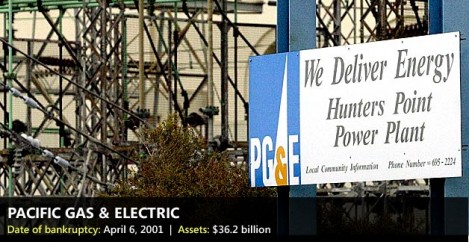
“California’s three big utilities lobbied intensely to pass the 1996 deregulation bill … The California utilities believed that they would thrive from electric utility deregulation and become international energy companies,” according to a 2001 Public Citizen report on California’s energy deregulation. “However, now that they have been beat at their own game by bigger and meaner companies like Enron, and [sic] they are crawling back to the legislature and begging for another consumer bailout.”
Instead of letting the deregulated market do its magic and let a more competitive company step in, PG&E lobbied California’s pliable legislators for a 40% rate increase and two rounds of bailouts that came to a total of $16 billion, courtesy of PG&E customers. In fact, the utility’s 5 million ratepayers are still paying for the company’s mistakes through mandatory fees. By the time PG&E’s bankruptcy-related debts are paid off in 2012, ratepayers will each have dished out around $1,500 to keep it from collapsing.
But wait, there’s more. Not only does PG&E enjoy a government-sanctioned monopoly throughout most of Northern California, but, on top of all the bailouts, California legislators have guaranteed the company 11% profit margins. It’s the kind of risk-free free market that corporate dreams are made of, allowing PG&E to squeeze $1.22 billion in pure profit from its ratepayer-suckers in 2009. Best of all, PG&E didn’t have to divert any of that cash towards paying down its debts — that’s what the customers are there for, remember? To show its gratitude, PG&E constantly jacks up electricity rates, skimps on service and generally makes its customers pay the highest electricity rates in the state. According to the Fresno Bee , PG&E charges double the average electricity rates of most public utilities and one-third more than its private counterparts in Southern California.
That kind of price gouging translates to some very attractive executive compensation packages. In 2009, Peter Darbee, PG&E’s CEO, received a compensation package of $9.4 million (earning a bit less than Goldman Sachs Group Chairman Lloyd Blankfein, who took in a total of $9.8 million in 2009). Darbee’s pay was up nearly 9% from the previous year, despite a 10% drop in PG&E’s profitability, according to the Associated Press. Since 2000, Darbee received a total of $48,560,044 in salary, stock options, pension benefits and bonuses, according to utility watchdog TURN.
But nothing lasts forever, and recently PG&E’s robber baron execs have begun to fear that their gravy train might be coming an end. It seems PG&E customers have started to finally wake up to the fact that they are being fleeced, and have started a slow-burning revolt that seeks to replace PG&E’s corporate monopoly with local public utilities.
To escape PG&E clutches, municipalities up and down California have been eyeing a 2002 law known as “community choice aggregation,” or CAA, which allows California cities and counties to become energy wholesalers who purchase power on behalf of their residents. The formation of CCAs poses a direct threat to PG&E’s monopoly by giving ratepayers greater bargaining power and allowing local governments to buy power from any energy producer — independent wind and solar energy companies, for instance — while using PG&E just for its power lines. In effect, it allows Californians to tap into and directly benefit from their state’s energy deregulation. “CCAs hold the potential for a substantial improvement in the energy market and increased efficiency,” determined a 2005 study of community choice aggregation by the Goldman School of Public Policy at the University of California, Berkeley.
Naturally, this had PG&E freaking out. After all, its business model is built on monopolistic price gouging, not competition.
Paul Hauser, an official from a municipal utility in Redding, a rural region in California’s far north, offered a glimpse into the kind of money PG&E stands to lose from a grassroots public utility revolution when he testified at a legislative hearing on Proposition 16 in February 2010. According to Hauser, customers served by his utility would pay an extra $440 per year if they had to be served by PG&E.
Now imagine the panic-stricken mental calculations that would shoot through a PG&E exec’s brain: $440 multiplied by 5 million ratepayers comes out to an annual loss of $2 billion in revenue, completely wiping out company’s profits. Just losing its monopoly in San Francisco, PG&E’s home city, could mean losing $140 million in income.
To protect its racket, PG&E has been waging war on uppity municipalities trying to enter the electricity business. Ever since the CCA law came into effect in 2002, the utility has been racing up and down the state, squashing local ballot measures that would enact CCAs with scare tactics and expensive disinformation campaigns.
In 2006, PG&E spent more than $13 million to defeat an attempt by Yolo County to join the Sacramento Municipal Utility District (which charges customers about a third of what PG&E does). Two years later, PG&E spent $10 million to squash San Francisco’s attempt to form a CCA that would allow the city to purchase a higher percentage of its electricity from green energy sources, something that PG&E could not provide. It was asymmetrical political warfare, with PG&E outspending the opposition in San Francisco 160 to 1.
The company’ most recent attempt to thwart the formation of a CCA was in Marin County, north of Golden Gate bridge going from San Francisco. PG&E launched a last-minute disinformation campaign, hoping to turn the population against the local CCA a few months before it was scheduled to become law in March 2009. Residents were barraged by inflammatory mailers with “frightening-looking graphics,” and pestered with phone calls from a supposedly independent group called “ommon Sense Coalition”telling customers to oppose the formation of a CAA, and fliers that predicted doom and gloom. Residents were shocked and turned off by the aggressiveness of the campaign. PG&E even threatened to stop supplying power to Marin if the CCA went into effect, and attempted to bribe cities with energy efficiency funds to opt out of the county’s CCA.
“They’re phone-banking, they’ve got call centers is Iowa and Palm Springs calling saying, ‘Do you know that your electricity is about to be switched [off] with no warning?’” a Marin resident told ABC News in April.
Marin’s CCA went into effect in March 2010 as planned, while PG&E’s strong-arm tactics resulted in an official rebuke from California’s Public Utilities Commission, which passed a resolution forbidding PG&E from refusing to supply electricity to CCAs.
But even while they were waging a losing war in Marin, PG&E’s brass had already switched strategies. With an upwards of 40 municipalities planning to break free of PG&E’s monopoly by forming CCAs, the utility decided to stop wasting money on local fights, figuring that it would be cheaper and more effective to take all the uppity municipalities all at once.
And that’s where the constitutional amendment comes in. PG&E CEO Darbee described his team’s eureka moment when they realized that the company could save a lot of money and effort by focusing its resources on pushing through a constitutional amendment to restrict public utilities, including CCAs, at a shareholders’ meeting in March 2010:
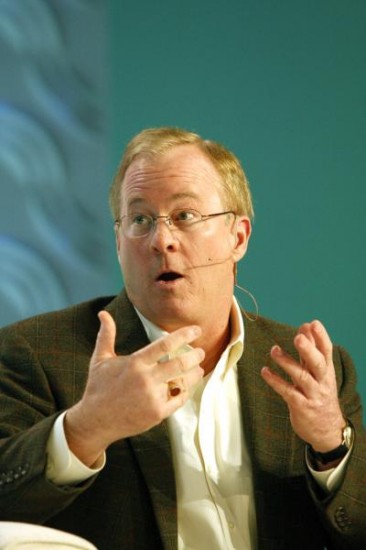
Does this pudgy dumbshit PG&E CEO look like he deserves $10 million a year of your money?
“[It] occurred to us that people aren’t very pleased with the job that government is doing these days in general, you know … in the context of what everything that is happening with government today — the dysfunctionality of it — we concluded that it was a very ideal time!” he said. There you have it. PG&E was going to use the good ol’ Republican “slippery slope to socialism” scare and spin the amendment as a way to stop and prevent government takeover of utilities.
Darbee was fully aware of the flak PG&E would get for trying to steamroll the amendment through, but he did not seem concerned. “[T]here’s going to be some flap,” he said. “And then, presumably, you know, we’ll mend any broken fences after that.” Time is indeed the best healer and, with our short memories, it’s quick, too.
PG&E’s first order of business was to set up a shell organization to initiate and sponsor the constitutional amendment. Calling itself ”Californians to Protect Our Right to Vote” (or “Yes on 16,” for short), the group pretended to be a grassroots coalition that represented the interests of every Californian — taxpayers, labor, environmentalists and businesses alike. In reality, its sole function was to mask the fact that PG&E is the sole backer of Proposition 16.
“In tough times, we should decide how our money is spent. That’s why we need Prop. 16,” says the Yes on 16 web site, painting Proposition 16 as a voter empowerment thing against big, bad government. “It requires voter approval before local governments can spend public money or incur public debt to get into the electricity business.” What Yes on 16 does not mention is that every single cent of the $25-plus million that had gone in and out of its coffers came directly from a corporation that would directly benefit from the amendment.
You can see the grassroot creds of Yes on 16 by looking at one of their spokespeople: Greg Larsen, a public relations man from Sacramento. Corporate flacks are obviously in high demand these days, because when Larsen isn’t shilling for PG&E at $25,000 a month (for a total of $250,000), he clocks in at his second job: shilling for the payday loansharking industry.
Here’s him being quoted by Southern California’s Press-Enterprise on April 15, 2010, while still a paid spokesman for Yes on 16:
Despite PG&E’s hyperactive propaganda campaign, opposition to Proposition 16 has been monolithic, which is highly unusual for a schizophrenic, multiple-personality-disorder state like California. Just about every politically active entity in the state has lined up against the amendment. Even the crooks over at the California Association of Realtors broke rank with the Chamber of Commerce and came out against Prop 16, which goes to show just how bad it really is. In December 2009, nine state senators sent a letter to Darbee , calling PG&E’s support of Prop 16 “misguided as a matter of public policy” and potentially illegal. While in March, six publicly owned utilities, as well as the city and county of San Francisco, filed suit against Yes on 16, hoping to disqualify Proposition 16 from the June ballot. The lawsuit claimed that the language of the proposition was “false and misleading”:
But even a broad-based opposition to Proposition 16 does not guarantee victory for California voters, not with the kind of moneyed game PG&E has brought to the court.
This is where democracy has brought us: the power of beneficial public agencies have been downsized, while destructive corporate power expanded. It’s been happening across America for years, and Proposition 16 would be just another step in the same direction. Because, if successful, the amendment wouldn’t just block competition from the public sector. It would turn the tables on the regulatory process and allow a corporation to impose regulations on municipalities, rather than the other way around. It isn’t deregulation, but regulation in reverse: corporations directly subjugating government through law.
It sounds outrageous, but it is perfectly legal here in the Golden State, where a form of “direct democracy” introduced 100 years ago allows voters to write laws straight into the state constitution. All that is required is a ballot initiative and a two-thirds majority vote by the people. Ironically, direct democracy was introduced to the state by the Progressive Party as a direct response to the runaway corruption of the Gilded Age, a way to shift power away from corporate and moneyed interests that dominated the legislature and to give it back to the people. Hiram Johnson, California’s progressive governor from 1911 to 1917, said that it would “restore absolute sovereignty to the people” by allowing voters to trump elected politicians.
It’s true, direct democracy gave California’s citizens a way to bypass their representative government, but it also gave a way for the rich and corporate to write their wishes directly into the highest law of the land — all they’d have to do is convince, cajole or dupe the people into voting their way.
And that is exactly what executives at Pacific Gas & Electric, a giant energy monopoly in California, decided to do. Over the past nine months, they’ve spent massive amounts of cash on political strategists, lobbyists, professional signature gatherers, astroturfers and political ad campaigns in the hopes of scaring and duping California residents into voting “yes” on Proposition 16 in the upcoming June 8 primary election.
Convincing voters to vote against their own interests hasn’t been easy, or cheap — especially when just about every newspaper in the state has come out with an editorial line attacking the amendment, which has been dubbed “PG&E Monopoly-Protecting Ballot Initiative” by some and a “tapeworm” by others.
The Sacramento Bee said that the amendment would ”insulate PG&E from competition, permanently locking its business advantage into the state constitution.” Mercury News called it “an outrageous measure…its sole purpose is to protect PG&E profits.” The Los Angeles Times waxed poetic, describing Prop 16 as “dagger aimed directly at a movement to enable municipalities to offer renewable green power to their residents in competition with private utilities.”
According to San Francisco-based utility watchdog, TURN, Proposition 16 would “sabotage existing law allowing communities to choose alternatives to PG&E” by mandating a two-thirds supermajority vote from residents in order for a municipality to form a public utility company or for an existing public utility to expand its services to new customers.
To push it through, PG&E’s political team has been waging a dirty political campaign that would make Karl Rove proud. As this article goes to print, records filed with the California Secretary of State show that the company had spent a whopping $25 million on the amendment. PG&E execs indicated that they are willing to spend up to $35 million. The utility has been using that cash to set up fake grassroots organizations to engage the Golden State in an aggressive, no-holds-barred disinformation war, airing misleading TV ads, launching aggressive direct-marketing campaigns and pestering people with telemarketing blitzes that warn of apocalypse if Prop 16 is not passed — doing all of it with their customers’ money.
“Never … have I seen political activity by a regulated utility so far outside the bounds of acceptable conduct,” said John Geesman, former executive director of the California Energy Commission, according to the San Francisco Bay Guardian. “It ought to be illegal to take ratepayer dollars and use it against ratepayer interests.”
True, it should be illegal for private companies to shaft customers with customer money, but it is nothing new for PG&E.
For starters, PG&E was one of the prime backers of the catastrophic law that deregulated California’s energy sector, which led to rampant fraud, manipulation and speculation in the electricity market by energy-trading companies like Enron, causing artificial electricity shortages, massive black-outs, 20-fold increases in electricity rates and, ultimately, to PG&E’s own bankruptcy.
“California’s three big utilities lobbied intensely to pass the 1996 deregulation bill … The California utilities believed that they would thrive from electric utility deregulation and become international energy companies,” according to a 2001 Public Citizen report on California’s energy deregulation. “However, now that they have been beat at their own game by bigger and meaner companies like Enron, and [sic] they are crawling back to the legislature and begging for another consumer bailout.”
Instead of letting the deregulated market do its magic and let a more competitive company step in, PG&E lobbied California’s pliable legislators for a 40% rate increase and two rounds of bailouts that came to a total of $16 billion, courtesy of PG&E customers. In fact, the utility’s 5 million ratepayers are still paying for the company’s mistakes through mandatory fees. By the time PG&E’s bankruptcy-related debts are paid off in 2012, ratepayers will each have dished out around $1,500 to keep it from collapsing.
But wait, there’s more. Not only does PG&E enjoy a government-sanctioned monopoly throughout most of Northern California, but, on top of all the bailouts, California legislators have guaranteed the company 11% profit margins. It’s the kind of risk-free free market that corporate dreams are made of, allowing PG&E to squeeze $1.22 billion in pure profit from its ratepayer-suckers in 2009. Best of all, PG&E didn’t have to divert any of that cash towards paying down its debts — that’s what the customers are there for, remember? To show its gratitude, PG&E constantly jacks up electricity rates, skimps on service and generally makes its customers pay the highest electricity rates in the state. According to the Fresno Bee , PG&E charges double the average electricity rates of most public utilities and one-third more than its private counterparts in Southern California.
That kind of price gouging translates to some very attractive executive compensation packages. In 2009, Peter Darbee, PG&E’s CEO, received a compensation package of $9.4 million (earning a bit less than Goldman Sachs Group Chairman Lloyd Blankfein, who took in a total of $9.8 million in 2009). Darbee’s pay was up nearly 9% from the previous year, despite a 10% drop in PG&E’s profitability, according to the Associated Press. Since 2000, Darbee received a total of $48,560,044 in salary, stock options, pension benefits and bonuses, according to utility watchdog TURN.
But nothing lasts forever, and recently PG&E’s robber baron execs have begun to fear that their gravy train might be coming an end. It seems PG&E customers have started to finally wake up to the fact that they are being fleeced, and have started a slow-burning revolt that seeks to replace PG&E’s corporate monopoly with local public utilities.
To escape PG&E clutches, municipalities up and down California have been eyeing a 2002 law known as “community choice aggregation,” or CAA, which allows California cities and counties to become energy wholesalers who purchase power on behalf of their residents. The formation of CCAs poses a direct threat to PG&E’s monopoly by giving ratepayers greater bargaining power and allowing local governments to buy power from any energy producer — independent wind and solar energy companies, for instance — while using PG&E just for its power lines. In effect, it allows Californians to tap into and directly benefit from their state’s energy deregulation. “CCAs hold the potential for a substantial improvement in the energy market and increased efficiency,” determined a 2005 study of community choice aggregation by the Goldman School of Public Policy at the University of California, Berkeley.
Naturally, this had PG&E freaking out. After all, its business model is built on monopolistic price gouging, not competition.
Paul Hauser, an official from a municipal utility in Redding, a rural region in California’s far north, offered a glimpse into the kind of money PG&E stands to lose from a grassroots public utility revolution when he testified at a legislative hearing on Proposition 16 in February 2010. According to Hauser, customers served by his utility would pay an extra $440 per year if they had to be served by PG&E.
Now imagine the panic-stricken mental calculations that would shoot through a PG&E exec’s brain: $440 multiplied by 5 million ratepayers comes out to an annual loss of $2 billion in revenue, completely wiping out company’s profits. Just losing its monopoly in San Francisco, PG&E’s home city, could mean losing $140 million in income.
To protect its racket, PG&E has been waging war on uppity municipalities trying to enter the electricity business. Ever since the CCA law came into effect in 2002, the utility has been racing up and down the state, squashing local ballot measures that would enact CCAs with scare tactics and expensive disinformation campaigns.
In 2006, PG&E spent more than $13 million to defeat an attempt by Yolo County to join the Sacramento Municipal Utility District (which charges customers about a third of what PG&E does). Two years later, PG&E spent $10 million to squash San Francisco’s attempt to form a CCA that would allow the city to purchase a higher percentage of its electricity from green energy sources, something that PG&E could not provide. It was asymmetrical political warfare, with PG&E outspending the opposition in San Francisco 160 to 1.
The company’ most recent attempt to thwart the formation of a CCA was in Marin County, north of Golden Gate bridge going from San Francisco. PG&E launched a last-minute disinformation campaign, hoping to turn the population against the local CCA a few months before it was scheduled to become law in March 2009. Residents were barraged by inflammatory mailers with “frightening-looking graphics,” and pestered with phone calls from a supposedly independent group called “ommon Sense Coalition”telling customers to oppose the formation of a CAA, and fliers that predicted doom and gloom. Residents were shocked and turned off by the aggressiveness of the campaign. PG&E even threatened to stop supplying power to Marin if the CCA went into effect, and attempted to bribe cities with energy efficiency funds to opt out of the county’s CCA.
“They’re phone-banking, they’ve got call centers is Iowa and Palm Springs calling saying, ‘Do you know that your electricity is about to be switched [off] with no warning?’” a Marin resident told ABC News in April.
Marin’s CCA went into effect in March 2010 as planned, while PG&E’s strong-arm tactics resulted in an official rebuke from California’s Public Utilities Commission, which passed a resolution forbidding PG&E from refusing to supply electricity to CCAs.
But even while they were waging a losing war in Marin, PG&E’s brass had already switched strategies. With an upwards of 40 municipalities planning to break free of PG&E’s monopoly by forming CCAs, the utility decided to stop wasting money on local fights, figuring that it would be cheaper and more effective to take all the uppity municipalities all at once.
And that’s where the constitutional amendment comes in. PG&E CEO Darbee described his team’s eureka moment when they realized that the company could save a lot of money and effort by focusing its resources on pushing through a constitutional amendment to restrict public utilities, including CCAs, at a shareholders’ meeting in March 2010:
[R]ather than year after year different communities coming in as this or that…and us having to spend millions and millions of shareholder dollars to defend it repeatedly, we thought that [a constitutional amendment] was a way that we could sort of diminish that level unless there was a very strong, you know, mandate from voters that this was what they wanted to do. … So it was really a decision about could we greatly diminish this kind of activity for all going forward rather than spending $10 to $15 million a year of your money to invest in this. The answer was yes!
Obviously, the amendment would be a hard thing to sell on its merits to California voters, as it would effectively force them to continue to pay double the rates that non-PG&E customers are charged for electricity. So, during the shareholders meeting, Darbee was very explicit about how they were going to dupe Californians into voting for it.Does this pudgy dumbshit PG&E CEO look like he deserves $10 million a year of your money?
“[It] occurred to us that people aren’t very pleased with the job that government is doing these days in general, you know … in the context of what everything that is happening with government today — the dysfunctionality of it — we concluded that it was a very ideal time!” he said. There you have it. PG&E was going to use the good ol’ Republican “slippery slope to socialism” scare and spin the amendment as a way to stop and prevent government takeover of utilities.
Darbee was fully aware of the flak PG&E would get for trying to steamroll the amendment through, but he did not seem concerned. “[T]here’s going to be some flap,” he said. “And then, presumably, you know, we’ll mend any broken fences after that.” Time is indeed the best healer and, with our short memories, it’s quick, too.
PG&E’s first order of business was to set up a shell organization to initiate and sponsor the constitutional amendment. Calling itself ”Californians to Protect Our Right to Vote” (or “Yes on 16,” for short), the group pretended to be a grassroots coalition that represented the interests of every Californian — taxpayers, labor, environmentalists and businesses alike. In reality, its sole function was to mask the fact that PG&E is the sole backer of Proposition 16.
“In tough times, we should decide how our money is spent. That’s why we need Prop. 16,” says the Yes on 16 web site, painting Proposition 16 as a voter empowerment thing against big, bad government. “It requires voter approval before local governments can spend public money or incur public debt to get into the electricity business.” What Yes on 16 does not mention is that every single cent of the $25-plus million that had gone in and out of its coffers came directly from a corporation that would directly benefit from the amendment.
You can see the grassroot creds of Yes on 16 by looking at one of their spokespeople: Greg Larsen, a public relations man from Sacramento. Corporate flacks are obviously in high demand these days, because when Larsen isn’t shilling for PG&E at $25,000 a month (for a total of $250,000), he clocks in at his second job: shilling for the payday loansharking industry.
Here’s him being quoted by Southern California’s Press-Enterprise on April 15, 2010, while still a paid spokesman for Yes on 16:
“The real impact of the proposed bill will be decreased consumer choice: unemployment check recipients will lose this option for short term credit in the marketplace,” said Greg Larsen, a spokesman with the California Financial Service Providers Association in Sacramento. “Payday loans are for such small amounts of money for such short periods of time, a 36 percent rate would not allow lenders to even cover their transaction costs.” He said the industry doesn’t “see how eliminating financial choices in the marketplace benefits consumers.”
Before that, Larsen defended an agribusiness outfit that poisoned people with their fecal spinach salad mixes, and also worked as a spokesman for a shady gambling industry group bizarrely named “A Fair Share for California, a Coalition of Law Enforcement, Educators and Labor, Supported by Horse Racing and Card Clubs.”Despite PG&E’s hyperactive propaganda campaign, opposition to Proposition 16 has been monolithic, which is highly unusual for a schizophrenic, multiple-personality-disorder state like California. Just about every politically active entity in the state has lined up against the amendment. Even the crooks over at the California Association of Realtors broke rank with the Chamber of Commerce and came out against Prop 16, which goes to show just how bad it really is. In December 2009, nine state senators sent a letter to Darbee , calling PG&E’s support of Prop 16 “misguided as a matter of public policy” and potentially illegal. While in March, six publicly owned utilities, as well as the city and county of San Francisco, filed suit against Yes on 16, hoping to disqualify Proposition 16 from the June ballot. The lawsuit claimed that the language of the proposition was “false and misleading”:
Faced with growing competition from local government entities providing better electricity service at better rates, Pacific Gas and Electric Company (”PG&E”) hit upon a cynical strategy to protect itself from competition: promote a constitutional initiative to require a two- thirds majority vote whenever local government seeks to provide service in an area under PG&E’s control. Since PG&E could not obtain the signatures to qualify such an initiative for the ballot or persuade voters to adopt it if its true purpose and effect were revealed, PG&E crafted the language of the initiative and the petition used to qualify it to appear to be an initiative to require a two-thirds vote for a local government to tax, borrow, or spend on electricity service systems.
Although the suit did not succeed in kicking Prop 16 off the ballot, it did succeed getting the ballot initiative a less deceptive title, changing it from “Californians to Protect Our Right to Vote” to “New Two-Thirds Requirement for Local Public Electricity Providers Act.”But even a broad-based opposition to Proposition 16 does not guarantee victory for California voters, not with the kind of moneyed game PG&E has brought to the court.
This is where democracy has brought us: the power of beneficial public agencies have been downsized, while destructive corporate power expanded. It’s been happening across America for years, and Proposition 16 would be just another step in the same direction. Because, if successful, the amendment wouldn’t just block competition from the public sector. It would turn the tables on the regulatory process and allow a corporation to impose regulations on municipalities, rather than the other way around. It isn’t deregulation, but regulation in reverse: corporations directly subjugating government through law.

Comment